

Shop floor · 5 min read
Before it ships: what a wrapped mold base is telling you
The last hour before a base is crated is when most of the easy mistakes are caught or missed. Here is what to look for on the plates, the wrap and the labels.
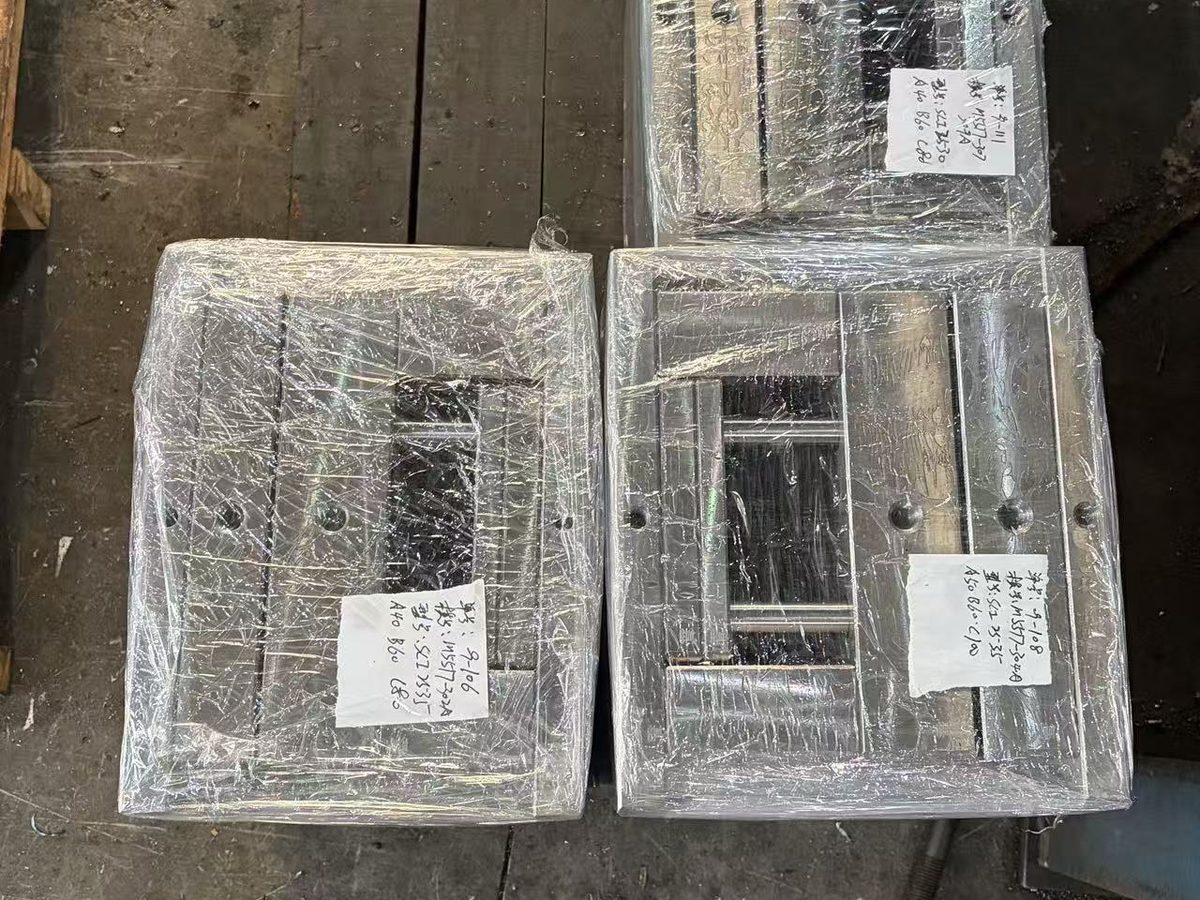
A finished mold base rarely looks impressive. By the time it is ready to leave, it is a stack of ground plates under stretch film, sitting on a skid, with a paper tag taped to the front. Buyers sometimes tell us it is hard to judge a supplier from a photo at this stage.
It is not. Everything worth knowing is in that photo, if you know which details carry information.
1. The wrap is tight and continuous. Stretch film is not decoration. Its job is to hold the plates in their assembled relation and keep moisture and swarf off ground faces in transit. Look for film that has been pulled tight enough to bridge across a pocket rather than laid loosely over it, and a wrap that goes right over the edges instead of stopping short of them. A base wrapped with visible slack around the corners has probably not been blocked against movement on the skid either.
2. Every plate carries its own tag. This is the detail that separates a shop that works in matched sets from one that pulls plates from a general pool. A mold base is not interchangeable stock: the A plate, B plate, spacer and ejector plates for one mold are machined as a set, and they only fit together the way they were cut. Each plate should arrive labelled with what it is and which set it belongs to, so the stack cannot be reassembled wrong on your floor — or, worse, on a shelf six months later when the job comes back.
If you are ordering several bases at once, ask whether the plates are identified per set. It costs a supplier nothing to do and a great deal to skip.
3. Machined faces are clean and dry, not bright with oil. Working faces get a protective coating before packing, but a face swimming in oil is a face that was not cleaned properly first. Chips and coolant left under a film wrap will sit against a ground surface in a humid container for weeks. Look for faces that read as dry metal with a thin even film, not puddles at the low corner.
4. The edges are deburred. Sharp edges are a handling hazard and, more practically, a sign of how carefully the finishing stage was treated. Edges that have been deburred are consistent all the way round the plate; a base finished in a hurry will have crisp edges on the faces that were measured and sharp ones everywhere else.
5. Guide-pillar bores are protected. The bores and any protruding pillar work are the first things to be damaged in transit, because they are the most exposed features on an otherwise flat stack. They should be covered, plugged or wrapped individually rather than left bare under the outer film.
6. The skid matches the weight. A base is dense. It should be blocked so it cannot slide and banded so it cannot lift, on timber heavy enough that the whole assembly can be lifted by forklift at the crane eye positions. Bases packed on a light pallet with the plates left to shift are how you end up with a parted-out stack and an insurance conversation.
What the labels should say. A tag with a drawing number and a set reference is worth photographing before the case is closed, because that photograph is what your receiving team compares against when the container is opened. It is also the fastest way for both sides to agree on what was shipped if a question comes up later.
Real size markings — the plate dimensions and the grade — are a reasonable thing to expect on the tag. On our own bases the wrap carries the plate reference, the set it belongs to and the material, so the stack can be checked in against the packing list without unwrapping anything.
Ask for the photograph. If a base is travelling a long way, ask your supplier to send a photo of the finished stack before it is crated and of the closed case before dispatch. It is the cheapest form of pre-shipment inspection there is: it catches a missing plate, a wrong set or an unprotected bore while the base is still on the floor rather than on the water.
We photograph finished sets and closed cases as standard, and the images go out with the shipment documents on request. Combined with the packing and crating sequence and the inspection record that travels in the case, your receiving team gets a complete picture of what should be inside before the container lands.
Send the drawing and tell us where the base is going, and we will quote the base with the packing and the photographs as one line item.
Related