

Shop floor · 6 min read
How a mold base ships in 7 days: from plate to finished stack
Seven days is not a discount on the process — it is a statement about which stages run in parallel. Here is the route a base takes through our shop, and where the time actually goes.
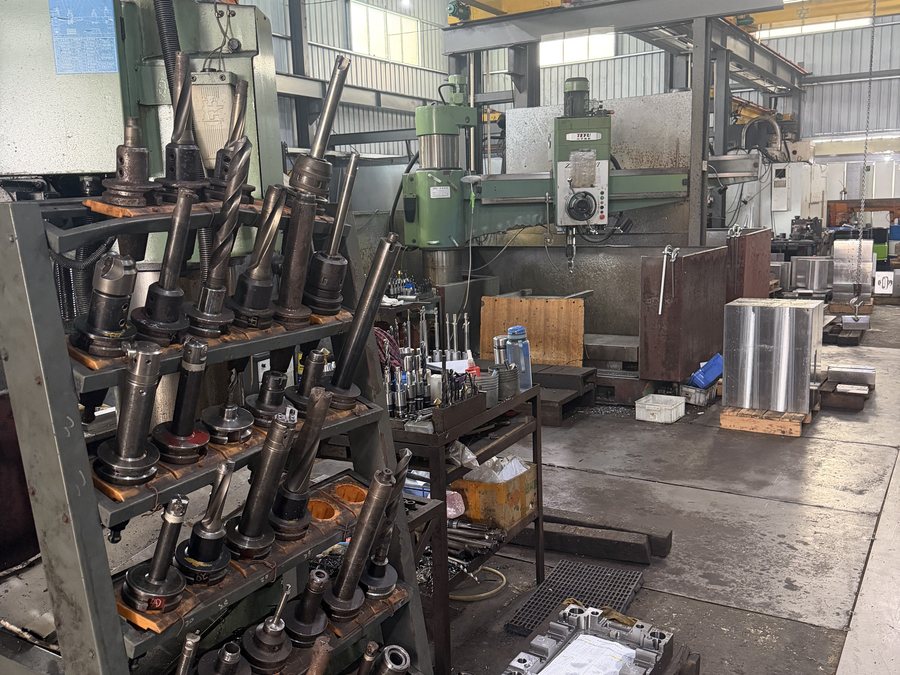
A seven-day mold base lead time raises a fair question: is anything being skipped? The honest answer is that nothing is skipped, but plenty runs in parallel. A mold base is not one long sequential job from a single machine. It is a stack of plates and a set of features, and the shop is organised so that most of those can be worked at the same time.
Here is the sequence, stage by stage, and why each one exists.
1. Drawing review and process planning. Before a plate is cut, the drawing is read against the stock we hold. Which plates come from standard stock, which need cutting from a larger block, which features have to be machined in the same setup to stay in relation to each other. This is the stage that decides the schedule, and it is why the seven days start at order confirmation rather than at the enquiry: the review has to be finished first.
2. Material prep and cutting. Plates are cut oversize to leave machining allowance, and identified. A, B, C plates from the same mold are kept as a matched set from this point on, not sorted into a general plate pool. Plate identification is the cheapest insurance in the shop — a set that gets mixed up is a set that has to be re-measured and, worse, re-fitted.
3. Rough machining. Faces and pockets are roughed with material left on every surface. This is where the bulk of the metal comes off, and it is not a precision operation. Roughing a plate removes a large amount of material from one side, which is exactly the operation that puts stress into it.
4. Stress relief. This is the stage buyers ask about most, and the one that decides whether the base is still flat in six months. Machining releases internal stress in the steel, and a plate machined heavily on one face will move after it is finished. Left in, that movement shows up as a parting line that closes at the clamp and opens at the far edge — or as a base that measured perfectly at our inspection room and no longer measures the same at yours.
So heavy plates are roughed, allowed to settle, and then finished. The sequence costs a day or two of floor time and it is not negotiable on anything that is going to be ground to a flatness figure.
5. Finish machining. Pockets are brought to size, apertures are cut, and tapped holes are put in. Non-standard pocket layouts, cooling routing and ejector patterns all land at this stage, all per drawing.
6. Boring the guide system. Guide-pillar and guide-bush bores are the features that decide whether the mold opens and closes where it should, so they get their own stage, done on the same machine in the same setup as the pockets they have to sit square to. Bores are positioned to ±0.02 mm, and this is why the guide system is not a job to farm out separately: the relationship between the bores and the pockets is the whole point.
7. Grinding and lapping. Working faces — the parting line, shut-off faces, mounting faces and any face that locates one plate against another — are ground and lapped flat and parallel to 0.02 mm / 100 mm, with ground surfaces finishing to Ra 0.8 µm. Milling alone gets you a surface that looks fine and does not seal; grinding is what stops flash. Datum faces are squared to the same class so the plates stack the way the drawing intends.
8. Inspection. Before anything is packed, the critical features are measured on a coordinate measuring machine in our temperature-controlled inspection room, against the figures that were confirmed in the quotation rather than against a general note. Records can travel with the shipment, so your incoming inspection is comparing against the same numbers we held.
9. Cleaning, rust protection and crating. Chips and coolant off, edges deburred, plates marked so the stack can only reassemble one way, working faces coated, and the base blocked and banded onto a skid. Packing is quoted as part of the job, not added afterwards, which is why it does not push the shipment date.
Where the seven days come from. Not every plate walks this route end to end. In a normal mold base the plates are worked in parallel: the A and B plates are on different machines at the same time, spacer and ejector plates run on a third, and the guide-system work is scheduled so it follows the pockets rather than queueing separately. The stages that genuinely cannot overlap are roughing, stress relief and finishing on the same plate — everything else is sequencing, and sequencing is what a shop with its own machining capacity can control.
That is also why a complete A/B assembly and a single plate tend to arrive at the same lead time rather than doubling it. A single plate on a small envelope may spend less time per plate but still waits its turn in a shared process; a full set uses the parallel capacity that is already there. At 2,000+ sets a month across two shifts, the queue is a normal part of production rather than an exception being squeezed in.
What pushes a base past seven days. Very large plates, deep pockets, and grades that are not pre-hardened and need a hardening step between roughing and finishing — because hardening distorts, so the plate has to be roughed, hardened, and then finished from the hardened state. Jobs with an unusual tolerance class take longer for inspection rather than machining. On anything in that list we quote a firm date instead of the standard figure, and the date is fixed before machining starts.
If the commercial side is settled quickly — drawing approved, grade and hardness named, deposit paid — the shop time is genuinely seven days. Most of the delay we see on late orders did not happen on the shop floor.
What you can do to keep it at seven days. Send the drawing early, even while the price is still being discussed, because the review is the long pole. Name the grade and hardness instead of leaving them open. Mark the datum and the functional faces so the inspection plan targets the right features. And tell us your fixed installation date with the drawing, so the schedule and the price come back in the same reply.
Because the steel, the machining, the inspection and the crating all happen under one roof with no middleman in the chain, a question about a base at stage 6 gets answered by someone standing next to it.
Send the drawing and we will tell you which route your base takes — and by when.
Related