

Shop floor · 6 min read
Why ground faces matter: the parting line, shut-off faces and flash
A mold base can hit every dimension on the outline drawing and still flash in production. When that happens, the cause is usually a face that was milled when it needed to be ground.
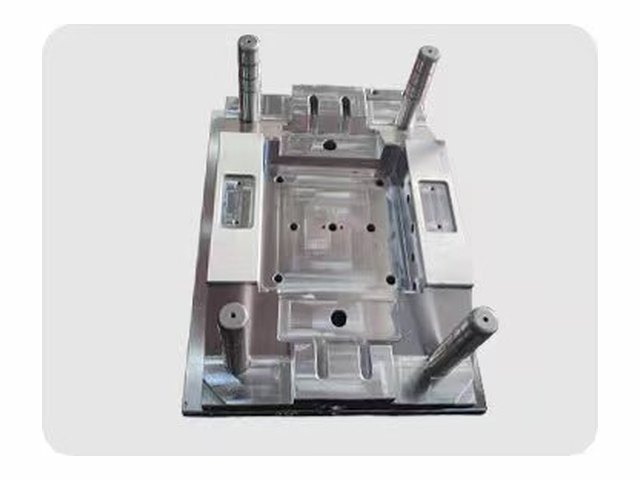
Grinding is the step that decides whether the two halves of a mold close as one piece of steel or as two pieces of steel with a gap between them. It is also the step most often trimmed out of a quotation to bring a price down, which is why it is worth understanding before the drawing is approved rather than after the first shot flashes.
What a milled face is, and is not. A milling cutter leaves a scalloped surface — the tool marks are visible to the eye — and it leaves the plate slightly bowed, because the material relaxes as metal is removed and the clamps hold it flat only while they are on. A milled face is flat by the standards of general machining, not by the standards a mold cares about, and the distance between the two is where flash comes from.
Why that distance matters. Melt is injected under pressure, and that pressure acts on the whole projected area of the part, pushing the two halves of the mold apart while the press and the steel deflect under it. What keeps the melt inside the cavity is steel closed against steel at the shut-off faces and along the parting line. Anywhere those faces do not close, the melt finds the gap, and the fin it leaves is flash.
Flash is charged for three times. Once in labour, because somebody has to trim every part. Once in quality, because a parting-line witness and dimensional drift at the edge are visible to your customer. And once in tool life, because a fin crushed between the faces on the next shot battens the very faces that were supposed to close. Flash is rarely a molding problem; it is a steel problem that presents as a molding problem.
Parallelism is the same argument measured differently. Every pocket depth in a plate is measured from one of its faces. If those faces are not parallel to each other, the same nominal pocket depth is a different real depth at one end of the plate than at the other, and the core and cavity close with a different gap at each end. On a thin-wall part the wall thickness follows that gap. Grinding is what makes the faces parallel to one another, not merely smooth.
What grinding actually changes. Surface grinding takes off the last few hundredths of a millimetre and changes three things at once: how flat a face is, how parallel it is to the face on the other side, and how smooth it is. On the bases we build, ground working faces are held flat and parallel to 0.02 mm per 100 mm and finish to Ra 0.8 µm; fitting and ground features — mold pockets, guide-pillar bores, shut-off faces — are held to ±0.02 mm. Above 600 mm the figure is agreed case by case, because thermal movement and handling make a blanket number misleading on a large plate.
Not every face needs it, and this is where money is spent for nothing. Grinding is machine time, and machine time is the largest part of what you buy. A spacer or backing plate in S50C is bolted into the stack and never meets the melt: grinding both faces adds hours and changes nothing about the part you mold. The faces that earn their precision are the ones that are fits — mold pockets, guide-pillar and bush bores, shut-off faces, parting faces and the datum. Mark those; leave the rest milled.
Two quotes, same size base, different numbers. When a quotation comes in well below ours, the difference is seldom the steel or the labour rate — it is which faces are ground and how much of the base is inspected. 'Fully ground' sounds safe, but on a standard stack it usually means paying for precision on plates that will never be a fit. Ask which faces a supplier grinds, and to what tolerance, and two quotes become comparable.
Tell us the datum. If your design measures from a particular edge or face, mark it. Half the grinding arguments we see are not a machining error at all, but two parties measuring the same base from two different references. The tolerance note covers the other callouts we usually ask about.
Hardening moves steel; grinding puts it back. A working face hardened after machining will move in the furnace however carefully it is quenched, and a grinding pass is what restores its flatness and its fit. Pre-hardened grades such as P20, 718 and 738 arrive at the hardness they will run at, which is why they hold flatness through a short lead time — there is no second heat to distort them after the final grind. If your mold does need hardening after roughing, say so with the drawing: the grinding pass and the extra days belong in the lead time.
Protection matters more on a ground face. A freshly ground face has no scale and no oil film on it: it is bare steel, and the most corrosion-prone surface in the base. Working faces, pockets and guide bores get a rust-preventive film before the plates are stacked, and on longer sea routes a VCI wrap as well, so the grinding hours are not lost to a damp container. How that protection is specified is covered in packing and shipping a mold base.
Inspection happens before the plates are packed. Flatness and parallelism on the agreed features are measured on a coordinate measuring machine, and the record can travel with the base. If your incoming inspection measures from the same datum, the numbers should match instead of starting a conversation. We do not quote a machine accuracy figure; we commit to the tolerance in the quotation, and to the record that proves it.
What to put on the drawing. Five lines cover it: which faces are ground; which are fits and to what tolerance; the datum; which faces you will finish yourself; and anything you want measured and reported. If you are unsure how much grinding is worth paying for, send the part information instead — wall thickness, annual volume, and whether the part is clear or cosmetic. A thin-wall housing and a crate lid do not need the same base.
Where grinding sits in the quote and in the week. Grinding is part of the base price here, not a finishing service bought in at the end: the quotation names the faces and the tolerance, and the shop that grinds a plate is the shop that machined it. Standard bases leave inside our seven-day window, and at 2,000+ sets a month the grinding load is planned into the week. One set is the minimum order, prices are quoted FOB China against your drawing, normally within one business day, on 50% deposit and 50% before shipment.
Send the drawing with the functional faces marked and the datum identified. That is enough for us to tell you which faces are worth grinding, which are not, and what the base will hold — before you commit to a price.
Related