

Die sets · 7 min read
A die set is not a mold base: what a press tool asks of the frame
Two plates, four guide posts, a stack of steel in between — the two frames look interchangeable until the machine starts. A press does four things to a die set that a molding machine never does.
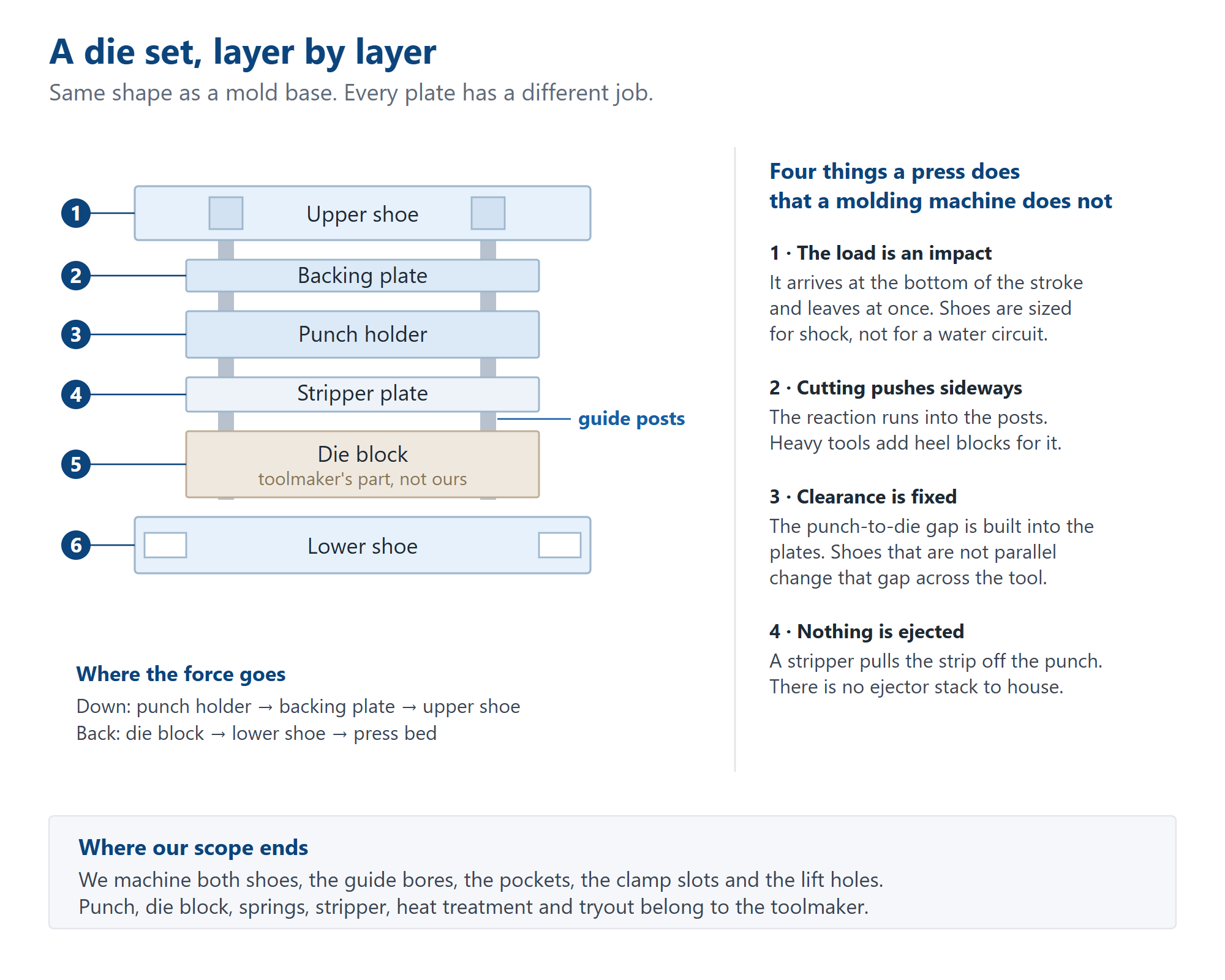
A die set and a mold base come out of the same bay looking almost interchangeable: two plates, four guide posts, a stack of steel in between. What separates them is the machine at the end. A mold base spends its life clamped shut while plastic fills a cavity, held at temperature for seconds at a time. A die set is struck — the ram comes down, the cutting edges meet a sheet of metal, the tool takes an impact, the ram lifts. That one change rewrites what each plate is for.
A die set is the frame of a press tool. The lower shoe sits on the press bed and is clamped through its slots; the upper shoe clamps to the ram; guide posts press into the lower shoe and run into bushes in the upper one. Between them the toolmaker adds the working parts — die block, punch holder, backing plate, stripper. We machine the frame and the pockets those parts sit in, which is the die set line, and the cutting geometry stays with the toolmaker.
The load arrives as an impact, from one direction. Force travels down through the punch holder and the backing plate into the upper shoe, and reacts up through the die block into the lower shoe and the bed. So the shoes are structural: sized for stiffness under shock, and sized to the bed they clamp to. That is why a die shoe is often thicker for its footprint than the equivalent mold plate, and why nothing in the frame needs a water circuit.
Cutting pushes sideways, not only down. As a punch enters the sheet the material resists, and the reaction tries to bend the punch; the guide posts are what stop that turning into a broken edge. In a mold base the guides mainly keep two halves in line while the clamp does the work. In a die set they take real lateral load, which is why heavy tools add heel blocks so the shoes share it — and why the guide detail on the drawing is a fit and a seat rather than a diameter. Ball-cage guides where the tool runs fast and the clearance is fine; plain bushes where the tool is heavy and slow.
Clearance is fixed geometry. In stamping the gap between punch and die is built into the plates by the tool designer, and it is meant to be the same all the way round the profile. Two shoes that are not parallel do not make the tool stop working; they make it cut differently at one end than the other, with a burr on one side and a heavy roll-over on the other. A plastic mold forgives the same error because the cavity is the part shape: parallelism there shows up as flash, not as the edge of a part.
A die set is quoted by its shut height. The press has a stroke and a shut-height window, and the closed stack has to land inside it; the lower shoe has to present clamp slots where the bed slots are, the upper shoe where the ram clamps. Lift holes matter as well, because a tool of this weight is moved with the crane. It is the same press interface as on a mold base, with different hardware.
The third plate is a stripper, not an ejector plate. A plastic mold pushes the part out from behind, which is why a mold base carries an ejector plate, return pins and a pattern of ejector holes. A stamping tool strips the sheet off the punch instead: the stripper is held down by springs or a cushion while the punches withdraw, and it has to be guided or it cocks and the punches bind. The frame work is therefore spring pockets, stripper guidance and clearance for the strip — not ejector bores.
No water in the frame, but heat still exists. A strip running fast heats the die block, not the shoes, and where a tool needs cooling the circuits belong to the block the toolmaker fits. What the frame does need is sound pockets, good dowelling and enough plate under the block that it cannot move. That is a different set of operations from deep-hole drilling a mold circuit — more boring and pocketing, less gun drilling.
What the drawing has to carry. Name each plate and its thickness; give the closed height; place the guide posts and say whether they are ball-cage or plain, and what fits them; mark which faces are fitting and which are clearance; dimension the pockets for die block, punch holder and stripper, and say whether the stripper is guided on the posts or on its own pins; show the clamp slots and lift holes; state the bed and ram interfaces. Anything left off becomes a question after the steel is cut.
Three things that go wrong at the enquiry stage. A photo of an existing die set is not a drawing: it carries no shut height, no guide fit and no clamp position, so it has to be guessed. A pocket called “to fit” without the block's actual dimensions is machined to a guess as well. And a die set ordered as if it were a mold base inherits mold-base assumptions — general-tolerance parallelism, ejector holes, no clamp slots — which describes a frame that cannot be clamped to the press. Buyers sourcing a die set from China tend to meet all three, usually in that order.
Where our work stops. We machine both shoes, the guide bores, the pockets, the clamp slots and the lift holes: fitting and ground faces at ±0.02 mm, ground faces at Ra 0.8 µm, non-fitting features inside a 0.3 mm band, anything over 600 mm agreed piece by piece, and CMM inspection before dispatch with the records travelling with the crate. The punch, the die block, springs, stripper, heat treatment and tryout belong to the toolmaker. We do not claim to build the cutting tool, and we would rather say so than quote for it.
The checks are the same whether the frame cuts steel or holds plastic, and they are the ones in what buying a mold base from China actually involves. Ask any supplier, Chinese or not, three questions: in how many setups the guide bores are machined, how the shoes are checked for parallelism after grinding, and whether the pockets are cut before or after the frame is stress-relieved. Ours are machined in our own shop in Dongguan, China, on 20+ three-axis machining centres; most orders run 7–10 days from confirmed drawing to shipment, the plant turns out 2,000+ sets and pieces a month, and you buy from the factory with no trading layer between the drawing and the machine.
Related