
Quotations · 7 min read
How long a mold base quotation holds — and what actually moves inside it
A quotation carries a date, and the date is usually the least understood line on it. Three costs sit inside the number and they do not expire together.
A quotation comes back from the buyer four months after it was issued, approved, drawing attached — and the number on the proforma is not the number on the paper. The buyer reads that as a bait price. Most of the time it is not. A mold base quotation is the sum of three costs, and only one of them is a market price that moved while the file sat in an inbox. Knowing which one is which decides whether you want a longer window or a shorter one.
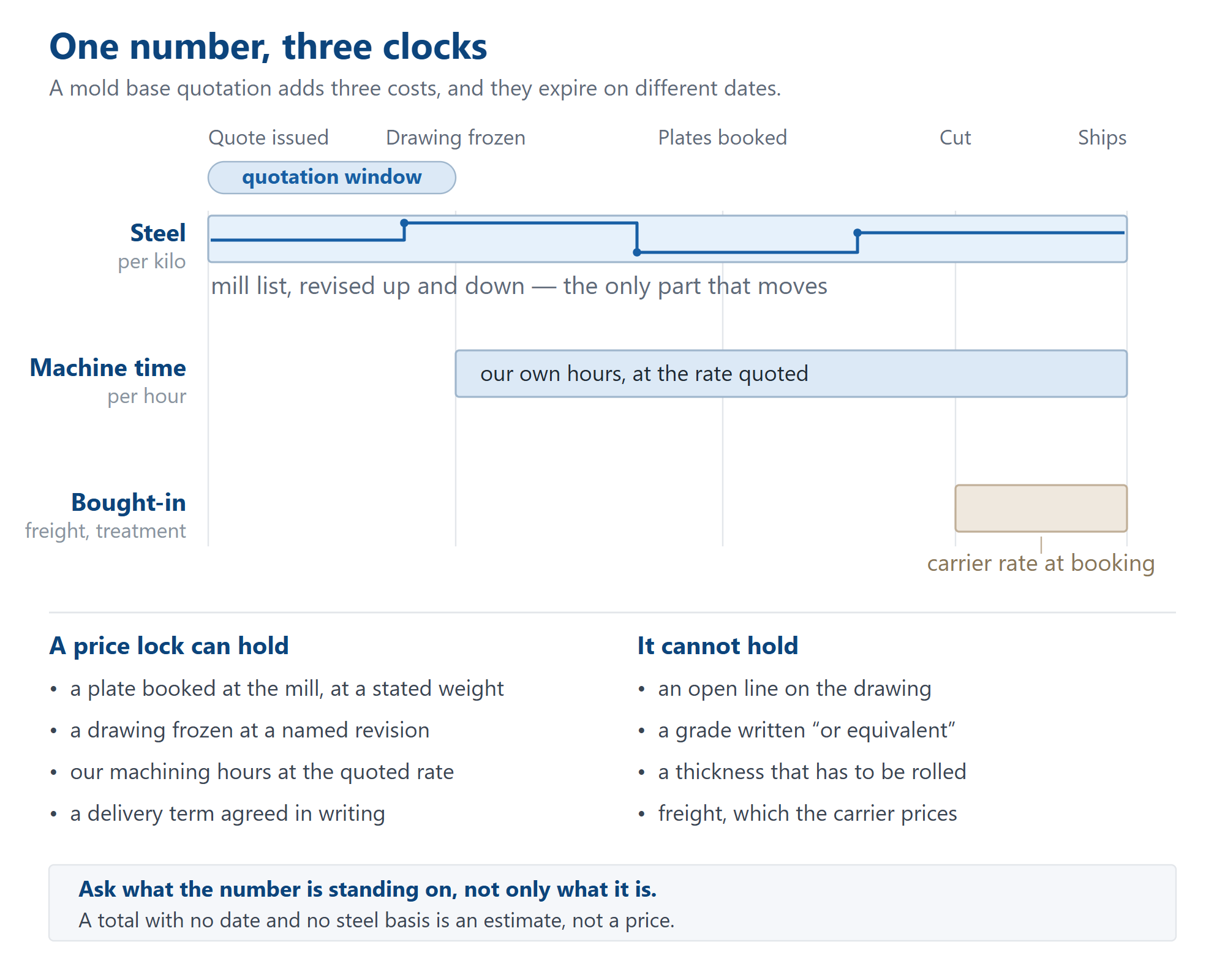
Three clocks inside one number. The plate is bought by weight, and the mill’s list for that grade is revised on the mill’s own schedule, up and down. Machine time is ours: an hourly rate for a machining centre, a grinder or a wire-cut, which does not follow the steel market and which we can hold for as long as we like. Bought-in steps sit in between — heat treatment, coating, purchased hardware, freight — quoted by somebody else, each with its own date. When a quotation goes stale, the part that moved is almost always the plate.
The plate is not reserved when you ask. Between the enquiry and the purchase order nothing is held. A mill sells at the list price current when the order is booked, and a quotation is not a booking. If the thickness is a stock item the plate is booked the day the deposit lands, and it may come out of a different lot: same grade, same specification, different heat number, different invoice. If the size is not stocked it is rolled or sawn to order, and the mill’s rolling schedule then sits inside your delivery date, ahead of anything we do.
So the window is written down, and it looks short. A supplier covering a long window has two options: pad the price today, or re-quote when the order arrives. We re-quote. A quotation good indefinitely is normally a quotation with the risk already inside it, and every buyer pays for that — including the one who orders next week. A validity window is not a sales lever. It is a statement about how far the steel has actually been checked.
What a price lock can hold. Three things, and they are worth naming precisely. A plate booked at the mill at a stated weight and grade. A drawing frozen at a named revision, so sizes and thicknesses cannot change under the price — which is what freezing a drawing is for. And our own machining hours at the rate quoted. All three are either ours or something we can buy on the day.
What it cannot hold. An open line on the drawing, because an open line is not a quantity yet. A grade written P20, or equivalent, because two words at the end of that line decide which plate is bought and at what price — the substitution problem in full here. A thickness that is not stocked and has to be rolled. A heat-treat or coating step nobody has defined. And freight, which the carrier prices on the day of booking, not us. None of these is a trick. They simply are not prices yet, and a quotation that claims to lock them is guessing.
A quotation should say what it is tied to. Two shapes are honest. Firm for a stated period, with the period printed on the document. Or a base price plus a steel adjustment calculated at booking, with the basis named: per kilo on the plate weight, against the grade’s list, capped at a figure both sides accept. What is not usable is a total with no date and no basis — nothing to check and nothing to hold anyone to later. Ask for that sentence in writing. A supplier who cannot write it has not priced the order, only estimated it.
Four things that expire a quotation before its date. An open line on the drawing. An oversize plate that has to be rolled rather than lifted off a rack. A grade callout with or equivalent sitting inside it. And a change after approval that turns a booked plate into a dead one. The first two are the mill’s calendar rather than ours, which is why a buyer working to a fixed installation date should settle the plate envelope early and leave the cavity detail for later.
The deposit is the date the clock starts. We work 50% with the order and 50% before shipment. The deposit is what turns a quotation into a booking; before it lands nothing is held at the mill and the window keeps running. If the window closes while the drawing is still being approved, say so before the cut — a price re-struck from the current list costs far less than a plate replaced.
How to put two quotations on the same basis. Same drawing, same grade and hardness range, same delivery term, same validity, same steel basis. Chinese suppliers quote in different shapes, so compare like with like: a CIF price and a DAP price are not equivalent, and neither is a total good for a month next to a total good for a quarter. The cheapest number with the longest window and no basis is often the most expensive order once it has been re-priced twice.
What we do at our end. We quote against a plate we can book that week, write the window and the steel basis on the quotation, book the plate when the deposit lands, and come back to you before the cutter moves if the booking falls outside the window. Plates over 600 mm are agreed piece by piece; fitting and ground faces run at ±0.02 mm, ground faces at Ra 0.8 µm, and CMM records travel with the crate. We would rather re-quote than quote a year out and pretend.
A quotation is a photograph of a shop at a moment: its rates, its suppliers and the price of steel on its floor. Ask when it was taken, what it is standing on, and how long it is good for. Three questions, and any supplier should answer them without looking anything up. Ours are machined in Dongguan, China, on 20+ three-axis machining centres; most orders run 7–10 days from confirmed drawing to shipment, the plant turns out 2,000+ sets and pieces a month, and you buy from the factory with no trading layer between the drawing and the machine. If you are still weighing up what buying a mold base from China involves, start with the quotation: it tells you more about the supplier than the price does.
Related