

Buying · 6 min read
“Or equivalent”: what happens to a steel grade between the drawing and the crate
Two words at the end of the material line decide which plate actually goes into the stack. Unlike every other line on the drawing, this one cannot be corrected once the plate is cut.
There is a habit in mold base purchasing of ending the material line with two words: P20, or equivalent. They keep an order moving, and they hand the supplier the choice of which plate goes into the stack. Every other decision in a mold base can still be corrected later — a pocket in the wrong place can be plugged and re-cut. A plate of the wrong grade cannot be adjusted at all: it is a new plate, a new heat and a new delivery date, arriving after the mold was designed around the old one.
Equivalence has to be measured against something. In a mold base there are only three references — the standard the grade belongs to, the delivery condition of the plate, and the mill that rolled it. Name a grade and nothing else, and none of the three is fixed. “Equivalent” then means whatever the steel trader had on the rack that morning, which is a reasonable way to buy structural steel and a poor way to buy the block your cavity sits in.
The name is not the specification. P20 is an AISI designation; 1.2311 is the German number for the same family; buyers write 718 for a stronger family, and write P20 for mill variants that were never pre-hardened at all. Two plates can carry the same word on the tag and differ in hardness range, in centre soundness, and in whether the mill delivered them annealed or pre-hardened. What the mold feels is the hardness, the cleanliness and the arriving condition — the same question as choosing a grade, asked from the other end of the order.
Part of what gets called substitution is not substitution. Another mill’s 1.2311, delivered pre-hardened into the same hardness range and the same condition, is the same plate to any mold. Refusing it buys a mill name on a certificate rather than a better cavity, and usually buys a longer lead time with it. That is the case the two words were invented for.
The case they were not invented for is one step sideways. 1.2311 and 1.2312 are the same family, and the second is resulphurised: sulphur is added so the steel cuts faster. The saving is paid back at the surface. Sulphur sits in the steel as inclusions, and inclusions do not polish — they tear, leaving drag marks and comet tails on a polished face. Under acid, on a grained or etched texture, they open as pinholes and streaks that polishing cannot remove because they sit below the surface. Nobody notices on a matte part; on a grained trim or a high-gloss face it is the first thing the customer photographs. If the drawing says 1.2311, 1.2312 is not equivalent however close the hardness reads.
The same distinction runs through P20 itself. Rolled and forged P20 carry the same analysis and a different history: a rolled block keeps its segregation and its porosity toward the centre, which is precisely where a deep pocket floor or a tall core ends up standing. On a thin plate that centre is never reached and the two behave alike. On a thick one the difference is soundness under the cut, and it shows as a floor that moves when the pocket is emptied. Forged P20 is a separate line for that reason, not an upgrade to sell.
Then the single letters. 718 and 718H are one family at two pre-hardened levels, and so are 738 and 738H. In a shallow cavity both hold. In a thin core wall under injection pressure the lower level creeps; the wall that measured correct at goods-in is thin at the top of the run, and the part that held tolerance for the first thousand shots does not hold it for the next ten thousand. One letter is a small difference in a quotation and a large one in a tool.
None of it announces itself. A substituted grade arrives in an identical crate, on a plate whose tag may say the right thing, at dimensions that check out. It appears at polishing, at texturing, at hardening — a plate supplied annealed instead of pre-hardened moves when it is finally hardened, and the pockets finished to tolerance are no longer in tolerance — or a year in, when a soft edge peens over and the part grows a witness line. That is the behaviour a delivery condition is supposed to prevent. By then the mold is built and the press is booked, and the argument is about who pays for the rework.
The fix is one line on the drawing with five things in it: the grade name, the standard it belongs to, the delivery condition, the hardness range you will accept, and a clause about substitution. Written out it reads: 1.2311 (AISI P20), pre-hardened as delivered by the mill, low-30s HRC on arrival, no resulphurised variant without written approval. A line like that gets answered. A bare grade name gets interpreted, and interpretation is where the two words do their damage. It also removes the second round of questions — the discipline a complete RFQ asks for, applied to the line buyers most often leave half-written.
Ask for two documents, and understand that they are not the same document. The mill certificate describes the heat that was analysed. The plate tag says which plate that heat became. Separately neither proves much about your order; together, when the heat number on the paper matches the number on the plate, they do. It is also why every plate we ship carries its number — on a second base the tag is what lets you confirm the same steel without cutting a sample. Check the pair at goods-in, not at assembly; that habit is what an inspection record is for.
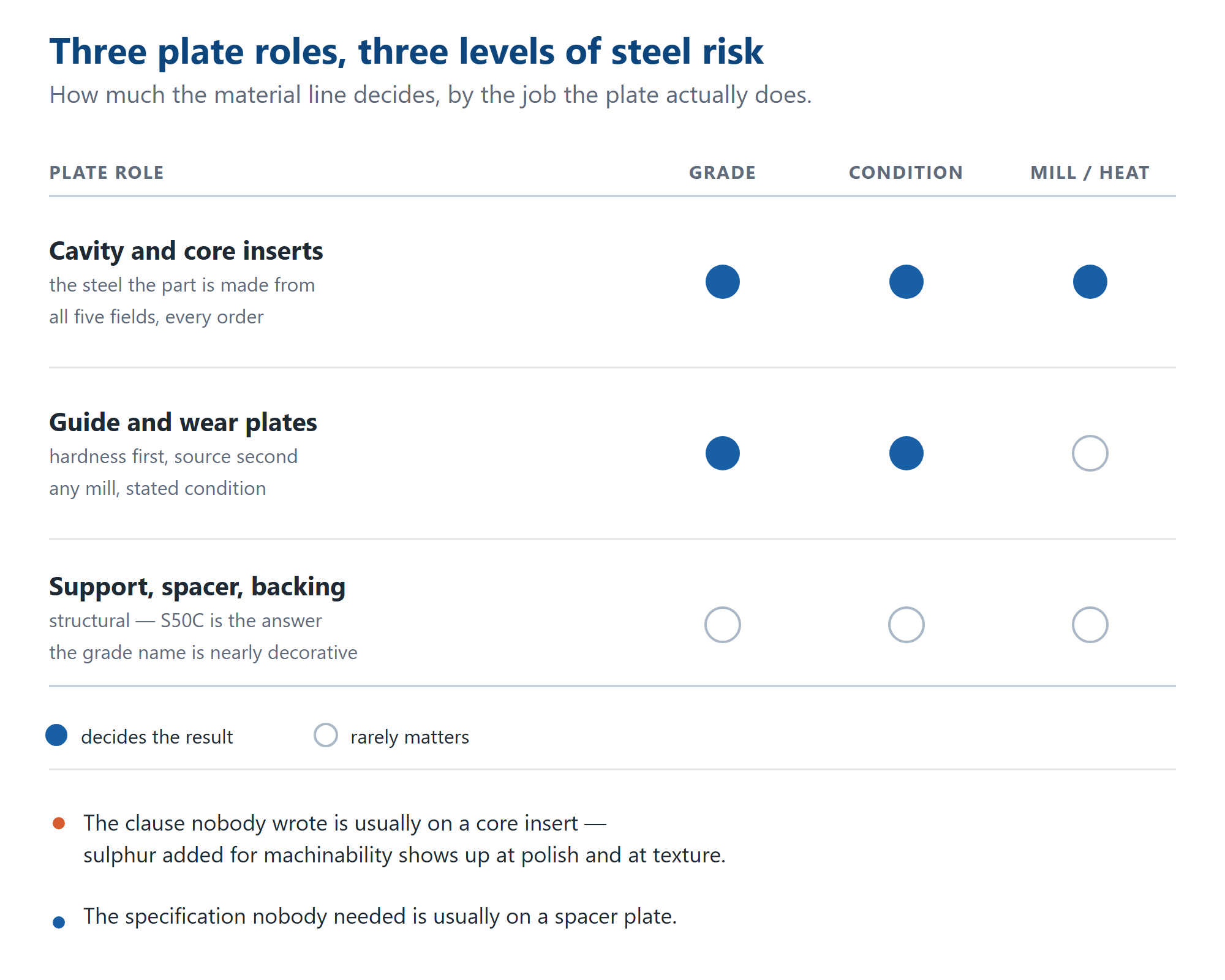
Not every plate deserves this much paper. A cavity block or a core insert deserves all five fields on every order, without exception — on a custom base it is the one line that decides whether the tool survives its own run. Guide and wear plates need the hardness and the condition right, and can take whatever mill is available. Support plates, spacer rails and backing plates are structural: S50C is the right material for most of them and the grade name above it is nearly decorative, which is why over-specification lands on a standard frame’s spacer plate. The misallocation runs both ways — the clause nobody wrote is usually on a core, the specification nobody needed on a spacer.
What we do about it: the twelve grades are cut in-house, so the steel and the machining are one order and one party to answer — the range sits under special steel supply. The standard we are cutting to is stated on the quotation rather than assumed, and if a grade has to change it is raised before the plate is cut, not explained afterwards. Most bases run 7–10 days from confirmed order to shipment, 2,000+ sets a month leave the shop, and the price comes from the factory floor, not a trading layer. If your drawing says “or equivalent” today, send it as it is — we will read the two words back to you before we quote.
Related