

Buying · 6 min read
A pre-hardened block is not a hardened mold base
Pre-hardened and hardened get used as if they were one purchase. They are not — and the difference settles what can be machined afterwards, whether the plate moves, and how long the whole job takes.
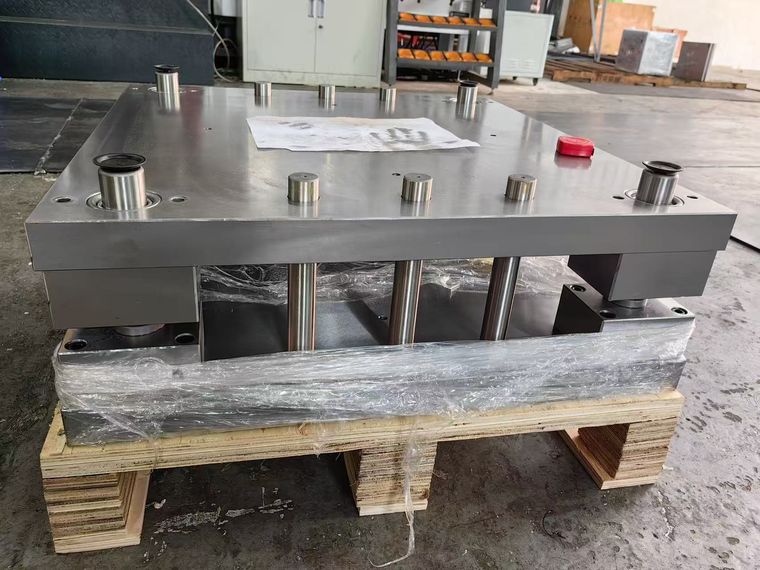
“Pre-hardened” describes the block you buy, not the hardness at the end. Steel arrives on the dock at a temper set by the mill, and everything that happens afterwards — roughing, pocketing, drilling, tapping, finish cuts — physically changes the condition of that plate. A customer reading pre-hardened 28–34 HRC on a mill certificate is reading a statement about delivery condition. It answers “can this be machined with the tooling we have”. It does not answer “will the working face still be at that hardness after a million shots” — the question the designer actually cares about.
Two different purchases, one word. Buying a pre-hardened base means buying the property it already has: a plate that can be rough-machined, pocketed and delivered without a heat treatment step, because the mill already tempered it to a useful working hardness. Buying a hardened base means buying a process instead — machine the plate in the soft condition, then harden it to a much higher figure and finish it afterwards. The second order contains the first order's machining plus a thermal step, so its price and its date come mostly from that step.
What the number controls. Hardness determines which cutter you can use, how deep one pass can go, how long a drill lasts and whether a tap survives a blind hole. A plate at 30 HRC is ordinary machining. A plate at 50 HRC cannot be turned with the same insert, cannot be drilled freely, and will wear out tooling at a rate that shows up in the quotation. It is why a hardened working face is specified on purpose rather than “for safety”: on high-runner tools, long-production jobs and most abrasive resins, it is what keeps a pocket at size. On short-run work it adds a step and a risk and delivers nothing the pre-hardened plate was not already delivering.
Hardening happens after roughing, which is when distortion appears. Heating a machined plate and quenching it moves it. The correct sequence is rough machining, heat treatment, then finish machining — which leaves metal on the plate for the distortion to eat before the finish cuts are allowed to land. Leaving that allowance out is where a hardened base goes wrong in the press: the pockets close a few hundredths on one side of the plate and open on the other, and the fit is lost before anyone looks at the part. This is also the reason the route costs days rather than hours, and why the seven-day window is normally quoted for pre-hardened and welded work rather than for hardened work.
Where the tolerance is decided, four times. Drawings often arrive with a single tolerance note intended to carry a hardened base from quotation to inspection — and it never does, because the condition of the plate is different at four points in the job. In the as-supplied condition, fitting and ground features are held to ±0.02 mm and non-fitting dimensions to 0.3 mm; that is the band the machining has to hit and the band our records are against. After hardening the plate will not measure the same — distortion is not a machining error and cannot be inspected away. After finish grinding it is brought back to the drawing. What is not recoverable is a pocket whose finish allowance was too small to begin with. Specify the tolerance for the condition you are inspecting in.
Grinding is part of the hardening job, not a separate purchase. A hardened plate has to be ground after heat treatment to bring the faces and the pocket walls back to size, and the ground surfaces finish to Ra 0.8 µm. The consequence is that hardness and grinding belong in the same sentence on the drawing. Buying a hardening process and a grinding operation separately puts a transport leg and a queue between two operations that have to be measured against one another, and the tolerance that gets lost is usually the one nobody re-checked.
Hardness does not stop at the surface, and the number does not say how deep it goes. Two plates can carry identical hardness figures and behave differently in service, because the figure alone says nothing about the depth of the hardened layer. Case depth is a question about the process, not about the number printed on a certificate — and it is exactly the specification a mill certificate will not give you, because the mill supplied the plate, not the treatment. Ask whoever treats it. It is a fair question, and the answer is a process description rather than a figure.
The failure you never see coming. A thin hardening skin becomes a crack at the pocket corner once the tool is running. A pocket that closed up after heat treatment shows itself as flash along a shut-off face, which is a grinding and flatness symptom until somebody measures the hardened plate. And a working face that was never as hard as the buyer assumed does not fail at all — it wears, slowly, over a very long run, the most expensive version of the problem because nobody notices until the part is out of tolerance. Each traces back to a decision made before the first cut, not to the machine that made the cut.
What to send with the enquiry. The hardness requirement per plate, on the working faces rather than the whole block; which features have to be machined after hardening; the finish allowance you want us to carry into that step; whether you are specifying a treatment process or only an outcome; the production volume or shot count the tool has to survive; and whether the plates should be supplied pre-hardened or hardened and ground. Give us those and the route can be planned and priced in one pass instead of being discovered halfway through — the RFQ checklist covers the rest of the pack.
What we can and cannot do here. Cutting and grinding are ours: pre-hardened plates at ordinary working hardness are standard work on three-axis CNC, we hold ±0.02 mm on fitting and ground features and 0.3 mm on non-fitting dimensions, and ground surfaces finish to Ra 0.8 µm. Heat treatment is not a furnace we run. Where a drawing calls for a hardened working face we machine the plate in the pre-hardened condition, plan the route and the allowance around the treatment, and hand the plate over for hardening and finish grinding so it arrives at your press at the figure the drawing asks for. Send us the hardness callout with the plate drawing and we will tell you which route applies, what it changes about the date, and what it costs.
Where it sits in our week. Most bases ship in seven days from order confirmation, in the same window as standard and custom non-standard work, at 2,000+ sets a month. Minimum order is one set, quotes return against the drawing usually within one business day, on 50% deposit and 50% before shipment. Anything that leaves the building for heat treatment is the exception in that schedule, and it is quoted with a firm date instead of the standard figure — better to know at the enquiry stage than after the plates are cut.
Related