

Purchasing · 6 min read
Plates, pillars and a number on every plate: what a mold base order contains
Two buyers order what looks like the same mold base. One crate holds plates; the other holds a stack that can be assembled on a bench without measuring anything. The difference is the item list.
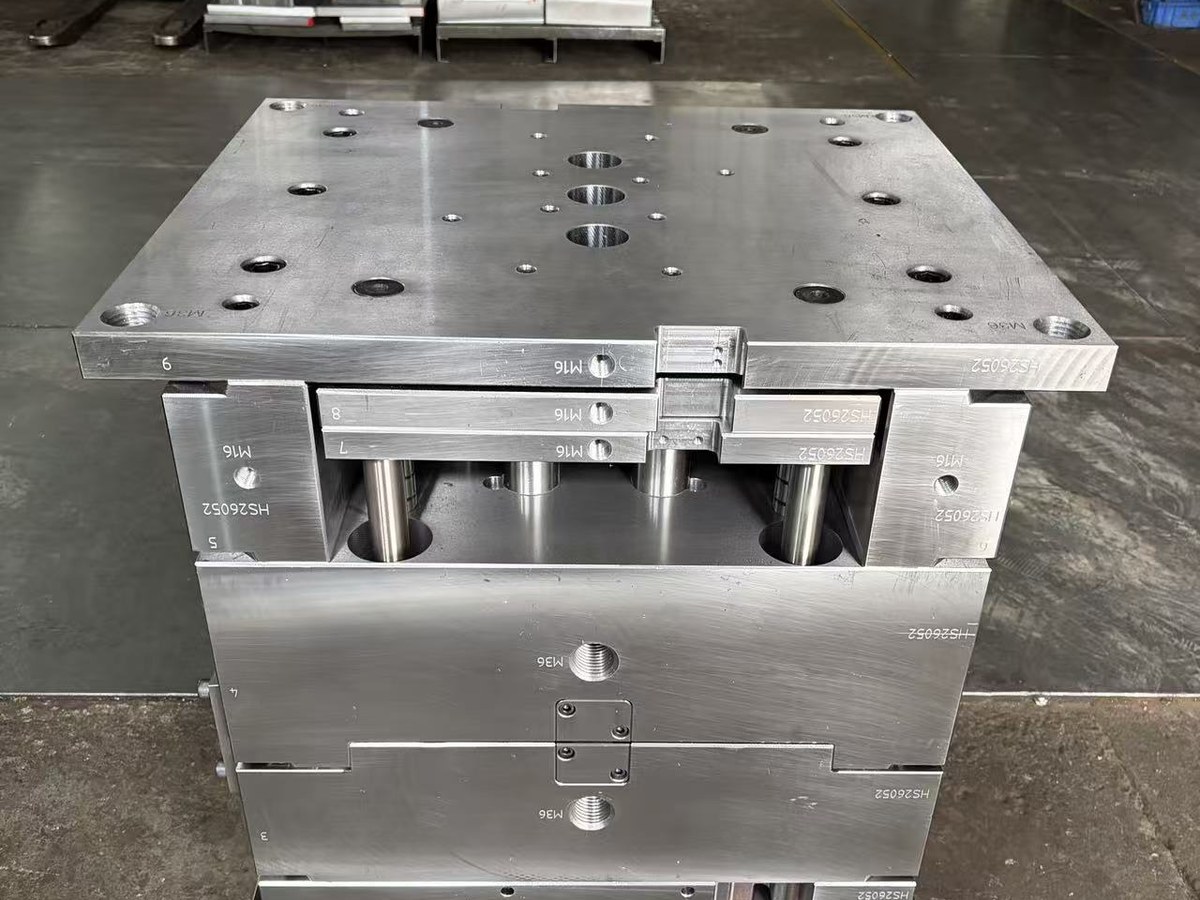
Two buyers order what looks like the same mold base. One crate arrives with plates only. The other arrives with plates, a guide set entered, screws bagged and taped to the side, and every plate stencilled with a number. Same drawing, same steel, different purchases — because “mold base” names a family of objects, and where you stop is a purchasing decision rather than a technical one. The item list is the thing to agree before the price.
The plates are most of it, and they are not one item. A two-plate base is already five or six pieces: cavity plate, core plate, backing plate, spacer, ejector plates, and a top clamping plate if the design carries one. Each is cut from its own steel and each has its own finish requirement — a backing plate is structural and can live at the general tolerance, while any face that shuts off or carries a guide bore cannot. A quotation for “one mold base” averages all of that away. Ask for the plate list with grade and finished thickness on every line and the quotation stops being an average; grade choice is per plate, not per order.
The guide set: fitted or loose, and it decides the bore. Pillars and bushes are a matched pair with the bores in the plates. If we ream the bore to the bush that will be pressed into it, the bush has to be the one in our hands — so buying the guide set locally and the base from us means agreeing the bush outside diameter first. If the base ships with bores only, the fit happens on your bench and the reaming is yours. Neither arrangement is wrong; assuming is what costs a week. The bore side of this is set out in guide pillars and bushes.
Dowels and screws are easy to leave off a purchase order. A base with every hole in the right place still needs a bag of dowels and a bag of screws. Three things go wrong here: the quantity, because how many dowels a joint needs is a design decision rather than a shop one; the standard, because an M-thread hole and a UNC hole look identical on a drawing until the screw does not enter; and the depth, because a blind hole is deliberately short of full thread and reads as an error on arrival. Say which of the three you want supplied. What the two fasteners do is in dowels locate, screws clamp.
The ejector side has its own hardware. Ejector plates need return pins, springs and stop blocks, and often a guide set of their own. The base can carry every hole for that. The hardware usually travels separately, because a mold maker prefers the springs and pins he already stocks — reasonable, as long as the hole sizes were agreed while the plates were still on the machine. A spring pocket cut for the wrong spring is a plate that has to come back. See ejector pin holes.
Lifting. Every plate heavy enough to need a crane needs a way to be lifted that does not involve a sling around a finished face. Tapped lifting holes are the normal answer, and their position and size belong on the drawing rather than in a conversation on the day of packing.
The number on the edge of every plate is the cheapest part of the order. A stack arrives as pieces that look alike: a spacer and a backing plate can differ by two millimetres and nothing else. Stencilling the plate number and the set number on the edge means the stack can be closed on a bench in the order the drawing says, without a caliper. Two years later, when one plate is damaged and a spare is ordered, that number is what ties the new plate to the base already in the press — without it, somebody measures six plates to work out which one is missing. Put the marking convention on the purchase order and keep it identical on the repeat.
“Assembled” needs a definition. It can mean the plates stacked and strapped; pillars entered and the stack trial-closed so the guide fit is proven; or the set screwed together. Each is a different amount of work and a different amount of risk in transit. On a heavy stack, screws are often bagged and taped inside the crate instead of run in, because a screw that works loose in a container is a screw that is missing on arrival — and the assembly gets done once, on your floor, where the plates can be cleaned first.
What is deliberately not in the crate. Cavity and core inserts, gates, runners, hot-runner manifolds and their wiring, water fittings, baffles and plugs, and often the springs and ejector pins. Some of that is design work that belongs to the mold maker; some is standard hardware that is faster to buy on your side of the water than to ship. This is where an order that felt complete quietly stops. Walking the drawing once, item by item, is the only reliable way to see which side of the line each one falls on.
An incomplete crate does not cost the missing part. It costs the mold build that stands still for a week waiting for a bush, the hour spent identifying an unmarked plate, the re-tap that puts swarf into a finished pocket, or the pocket roughed to a stock nobody agreed and then finished elsewhere without the same datum. None of that appears in a price comparison, and all of it is decided by four lines of text that could have been on the purchase order.
Four lines that keep a crate complete. The item list, with a quantity against each item. Which items we supply and which you do. The thread standard, and how blind-hole depth is to be read. Whether the plates are marked, and how. Add a fifth when the base ships assembled: what assembled is supposed to mean.
We cut the plates, the bores, the pockets and the threads on one floor, mark the stack and check it before it is packed. Most mold bases leave in 7–10 days from order confirmation, on a floor that turns out more than 2,000 sets and pieces a month, with no middleman between your drawing and the machine that cuts it. Whether the order is a custom base machined to your drawing, a standard size or a complete mold built around the base, the crate is only as complete as the item list behind it — so send that list with the drawing and we will confirm the scope line by line before anything is cut.
Related