

Buying · 6 min read
FOB, CIF or DAP? Reading the delivery term on a mold base quote
The three letters at the foot of a quotation decide who pays the freight and who owns the risk once the crate is over the rail. Compared on different terms, two prices for one drawing mean nothing until you put them on the same basis.
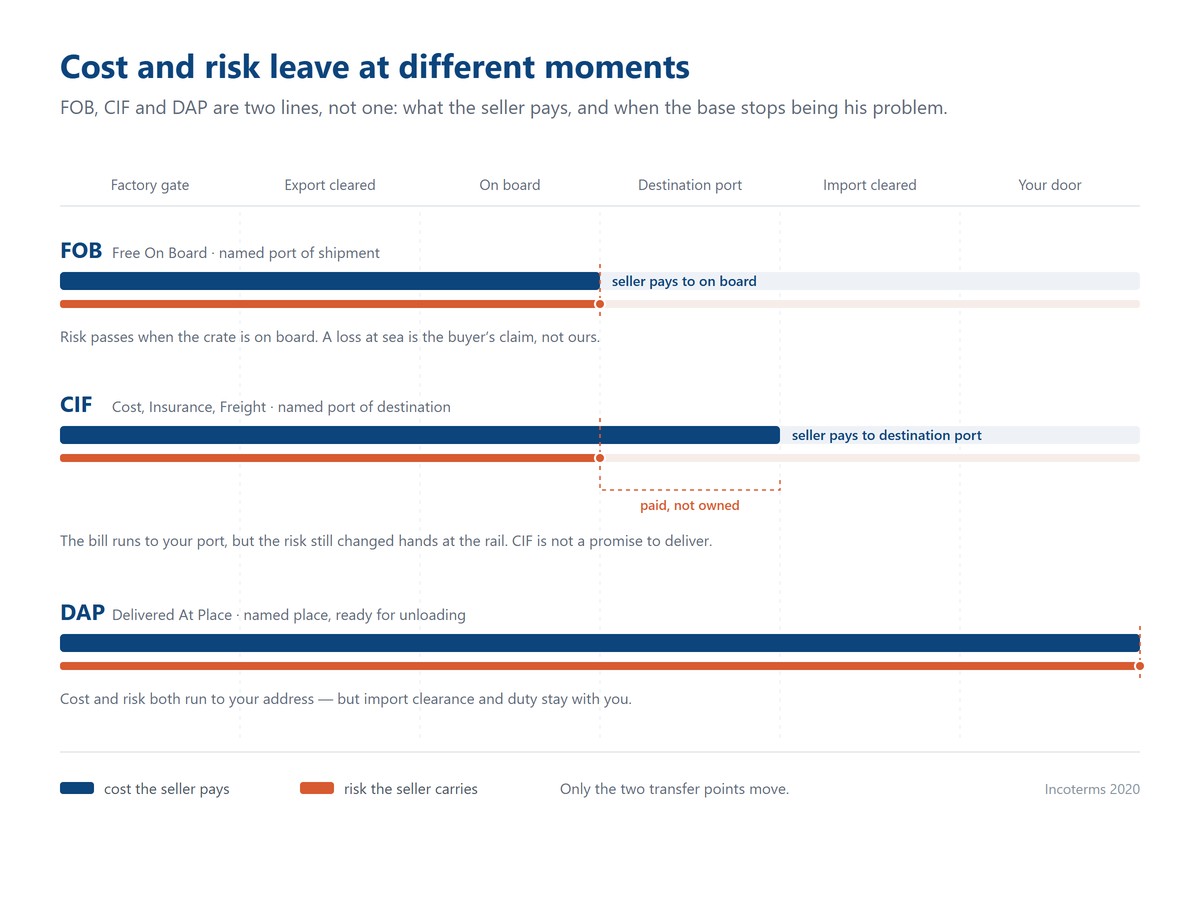
Two quotations for the same drawing rarely differ only in machining. A finished mold base is heavy steel, so freight, insurance and terminal handling are large numbers beside the plate cost — and the three-letter code at the foot of the quote decides who pays each of them, and at what moment the base stops being our problem and becomes yours.
That is the whole job of an Incoterm. It fixes two things at a named place: the point where cost transfers, and the point where risk transfers. Nearly every argument about a crushed corner, a destination fee nobody budgeted for, or an export declaration that could not be filed comes back to those two lines being read differently.
Cost and risk are two separate lines. Under FOB, CFR and CIF risk passes when the goods are on board the vessel — but under CFR and CIF the seller keeps paying freight to the destination port. A CIF price does not mean the seller is responsible until the base reaches your port; it means the seller has paid a bill that runs that far. Once the crate is over the rail, a loss at sea is your loss and your claim, not the supplier's.
The four terms you will actually see on a mold base quotation are EXW, FOB, CIF and DAP. EXW stops at our door, and the buyer does everything from loading onwards. FOB stops when the base is on board at the named port of shipment. CIF adds ocean freight and a minimum level of insurance to that same port. DAP runs to an address in your country, ready for unloading, with import clearance and duty still yours. DDP goes further, and under DPU the seller also unloads; neither is common on steel.
EXW carries one trap that matters in China. It looks cheapest because it carries no freight, but it assumes the buyer files the export declaration. In practice that declaration is filed here, in our name, against our licence, and a buyer with no entity in China usually cannot file one at all. Before comparing an EXW number with an FOB one, ask who files the export papers: an EXW quote that needs a local agent to export is not cheaper once the agent is paid.
FOB is written for cargo going on board a ship, and that is the cut-off — on board, at the named port, not at our gate. A correct FOB figure includes inland transport, export clearance and origin terminal handling, so if your forwarder later bills you for “origin charges”, check what was already inside the price. One note: for containerised cargo handed over at a terminal, FCA is the term that matches the handover, and FOB is used loosely. Most quotes say FOB and most forwarders work with it, so the label matters less than agreeing the named place and the cut-off in writing.
CIF buys freight and the minimum insurance, not cover. The insurance a CIF seller is obliged to arrange is the cheapest class — named perils and major casualties — and it is weak on the losses that actually happen to a machined base: handling damage, water ingress, condensation inside a container. If the base matters, agree a wider cover and the insured value before shipment, and ask for the certificate before the vessel sails. Insurance arranged by the seller is still for the buyer's benefit: the claim is yours to make.
DAP is what buyers ask for when they want one number, and it hides the most work. The seller delivers to the named place ready for unloading; import clearance, duty and the unloading itself stay with the buyer. Unloading is the line people forget: a case of a few tonnes on a truck needs lifting equipment at your end, which a DAP price does not provide. “DAP Jakarta” is not a place either: the term needs the factory address, because the last kilometre is where the cost and the argument sit.
Destination charges are where the surprise lives. Under FOB, CFR and CIF the terminal handling at your port, the documentation fee, the customs broker and any demurrage are yours, and on a heavy crate they are not small. CIF pays freight to the port, not delivery to your door. Before comparing two quotes, ask your forwarder for a door-to-door figure against each of them, so you compare one journey rather than two halves of it.
This cargo is priced on weight, not on space. LCL freight is charged on the greater of weight in tonnes and volume in cubic metres, and steel is dense: a pallet of plates that takes very little room in a container still charges at close to its real weight. Packing tight saves handling and damage, not much freight. Air freight suits small plates on a deadline, rarely a full base — which is why the crate on oversize plates and large machined plates is a protection decision first and a cost decision second.
What the term does not cover matters just as much: the packing spec, the rust protection, whether the inspection records travel with the case, whether a certificate of origin is included, and whether the case is solid wood. Solid-wood packaging is required to be heat-treated and marked to ISPM 15 in most importing countries, while plywood is exempt in most markets. None of that is in the three letters, and any of it can stop a container at the border. It belongs on the packing specification, agreed with the order.
How to compare two quotes in three steps. Put both on the same term and the same named place. Confirm what is inside each number — crating, VCI, inspection, documents, origin certificate. Then read the delivery date against the same starting point, because a term and a date are read together: the four dates in an order decide whether a shipment date counts from deposit or from drawing approval. A price that looks lower on a different basis is a different product, and the difference lands in your forwarder's invoice.
What to send with the RFQ. The destination port or the factory address, the term you want to buy on, who will be the importer of record, the heaviest case your receiving bay can lift, whether you need a certificate of origin for a preferential tariff, and whether you want insurance arranged. Those six lines remove most of the follow-up questions and make the price comparable with the next supplier's before either of you has quoted.
Where our own quotations stand. They name the term and the port rather than leaving them to be assumed: the published basis is FOB China, with CIF to your port available. If another term suits you better, ask for it in the RFQ. The base itself is the part we control: custom and non-standard bases machined to your drawing, seven days from order confirmation to shipment on standard work, over 2,000 sets and pieces a month through our own machines, and no middleman between the person who quotes the term and the person who builds the case — which is why a case-number question is answered off the shop floor.
Related