

Shipping & packing · 6 min read
Oversize plates: packing is a handling system, not a box
On an ordinary base, packing is the last operation and it is settled by habit. Past a certain size it stops being a container and becomes part of the job — and the parts of that job that decide the outcome are agreed while the part is still being quoted.
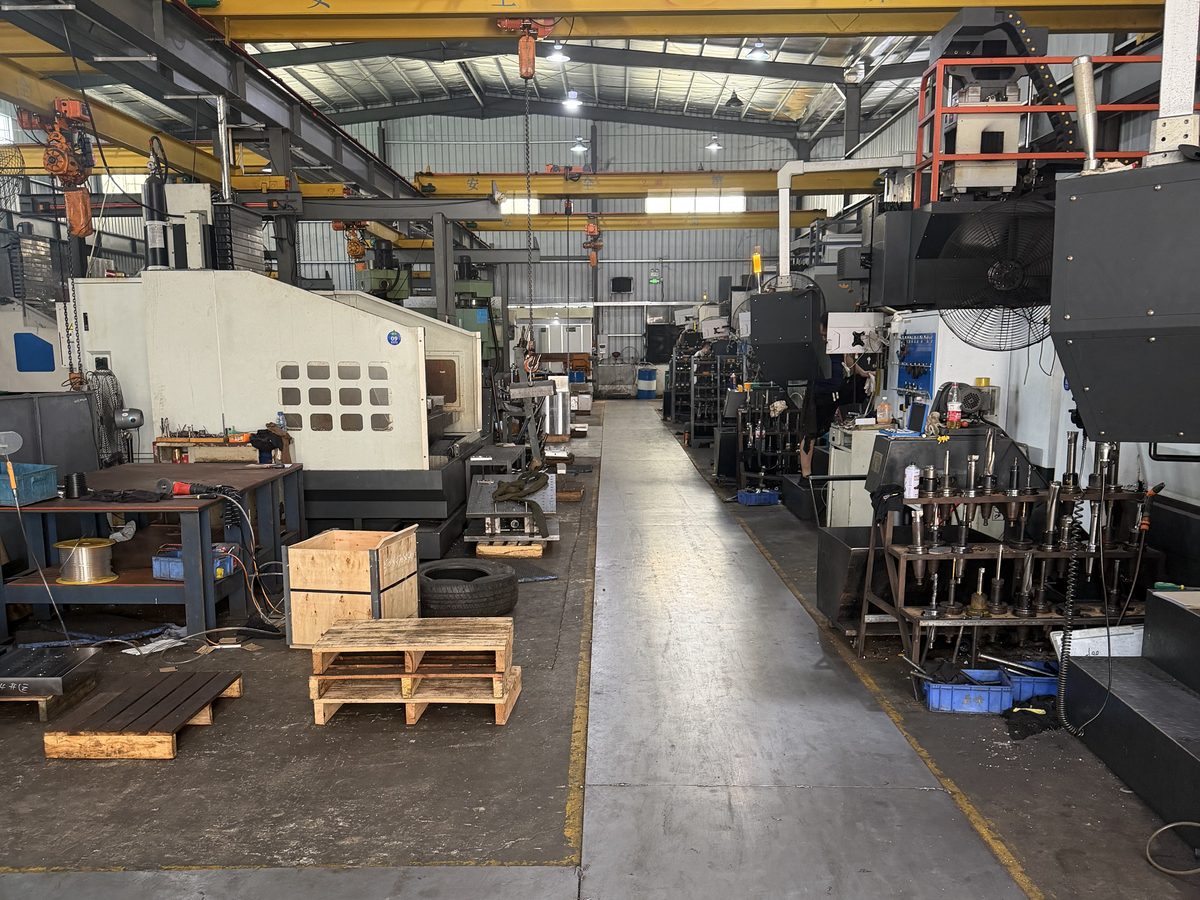
On an ordinary mold base packing is the last operation, decided by habit: film, block, band, case. Past a certain size it stops being a box and becomes the handling system for the whole shipment — and most of what goes wrong at the far end was settled at the enquiry, by an answer nobody asked for.
Nothing is oversize on its own. A part is oversize relative to whatever has to lift it: the same plate is ordinary at a plant with a crane over the unloading bay and oversized where it comes off a tail-lift on a pallet truck. So two facts belong with the drawing from the start — the heaviest single piece your site can lift, and how the shipment will come off the truck: forklift, overhead crane, ramp, hired crane. Those answers decide the skid design, whether the order ships as one piece or several, and often what the freight costs — detail of the same kind as the RFQ checklist.
Which is why the far end decides the near end. If the receiving bay has only a forklift, the load has to sit on a skid with clear fork access, and every piece has to fall inside that forklift's capacity rather than the case's. If it is lifted by crane, there have to be lifting points — marked, because whoever rigs it has never seen the part. If the address has neither, whether the order can travel as two sections is a question about the drawing, not the packing. Ask it at quotation; a crate cannot be redesigned in a port.
A case for a long part is a beam, not a box. A long plate on a short skid overhangs at both ends, so the weight travels through the middle of the plate, and a plate held at its ends and pressed in the centre bends — the ground faces take the bend. That is the same point about support as on the machine. So runners and fork pockets go under the mass, near the lifting points, and the part is fastened down through its own holes rather than laid in and blocked. Blocking is enough for a short plate; a long one has to be held.
Size also changes what the shipment costs, and not the way buyers expect. Freight pays for volume, and an over-length case cannot be stacked or nested: two over-length pieces take twice the floor of a container, not the space one and a half would. A case that will not fit a standard container is a different booking, at a different price, with its own lead time — which is why the finished crate dimensions and gross weight need to exist early, as numbers that go into the shipping enquiry.
When a part passes the handling limit at either end, the honest answer is usually to split it — and the useful split follows an interface the part needs anyway: a joint, a parting line, a section that had to be machined separately regardless. A split decided by whoever builds the case, cut wherever it happens to fit, produces two pieces nobody meant to join. Raise it while the drawing is open and it costs a joint; raise it after the case is built and it costs a rebuild.
Then there is marking, the part of packing that gets treated as decoration. Three things belong on the outside of an oversize case: the gross weight, the centre of gravity, and how it may be lifted — fork here, crane here, not here. The centre-of-gravity mark is the one that gets left off and the one that tips a case onto somebody. The part's own lifting points are marked too, because the case will be opened at the other end by someone working from a packing list and whatever is written on the timber.
Bearers and blocking also have to touch something, and the packing plan decides what. Contact on a rough face costs nothing. A sling or a timber across a ground face is a repair; if the contact point lands on a datum, the argument afterwards is one nobody can win. If one face is the datum your incoming inspection will measure from, it gets the film, the padding and a no-contact rule — the same faces the tolerance callouts already single out. The faces that will be cut again, or hidden inside the stack, take the cribbing.
Long cases and long voyages need one more thought. A large case holds more air than a small one, and air carries moisture, so rust protection — a film on every machined face, a VCI wrap inside the case on longer routes — only does its job if the case is closed as designed. A case finished with the sheathing short at one end gives that protection away where the buyer cannot see it. The packing page covers what goes inside; on a big case, closing it properly is harder and matters more.
This is what the extra money for an oversize part buys, and why two quotes can sit far apart. The gap is rarely the steel. It is the skid: built to the part, or bought ready-made and made to do. It is the number of lifts at both ends, and whether anyone counted them. It is whether the case is built around the part or the part forced into a box that already existed. The question that reaches it: “How will this be lifted at each end, and how will it be restrained in the container?” A price with no answer is a price for the steel only.
At the receiving end the sequence matters more than the speed. Photograph the case before the banding is cut. Match the plates against the packing list before anything leaves the loading area; a large plate set down in the wrong bay is hard to identify later. Unbolt last: the bolts holding the part to the skid are usually its lifting points, so lift on those, not on webbing passed round a finished face. After that the checks are the same as for any base, and the arrival checks list them. What differs on a large part is that a mistake costs crane time, not a second pair of hands.
Most oversize work is ordinary for us, planned around the machine envelope, the crane and the number of times the part has to be moved. The same discipline that gets a standard base off our floor in seven days is what a long plate is planned around. With over 2,000 sets and pieces a month moving through our own plant, crating for sea freight is routine here rather than a service bought in at the end. And with no middleman between your drawing and the person who builds the case, the lifting question is answered by whoever will do the job. Oversize plates are on the large mechanical plate page, beside non-standard formats and precision ground bases, with the cranes on the factory page. Send the drawing, the destination port, and how the crate will be unloaded at your end.
Related