

Machining · 6 min read
Large plates: what changes when the part gets big
A big plate does not fail for new reasons. It fails for ordinary ones a small part forgives — and the price is largely the story of how many times somebody had to pick it up.
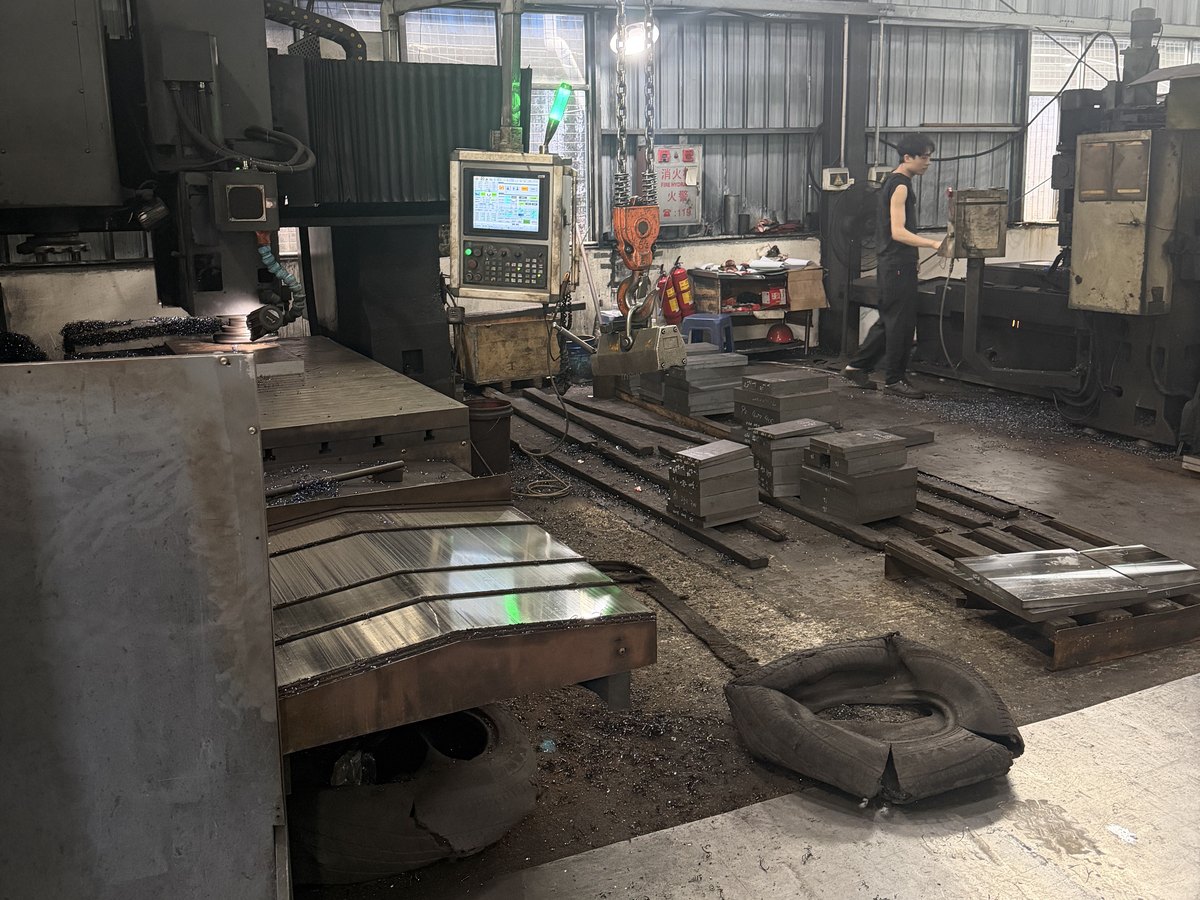
Large-plate enquiries usually arrive as a scaled-up version of something ordinary: the same pockets, the same bores, twice the length, one drawing instead of two. On paper it is the same job. On the floor it is not. A large plate does not fail for new reasons — it fails for ordinary ones that a small part forgives: a clamp that pulled it down, a turning that moved the datum, a cut that let the stress out, a lift that bowed it. The cost of a large plate is largely the story of how many times somebody had to pick it up.
Start with what can reach it: table size is the easy part — the deciding figure is how far the cutting edge can be presented rigidly, as the note on cutters and reach sets out. A plate that cannot be reached from one setting comes off the table between operations, and each of those moves ends a setup and begins another.
A big plate also has to be supported, not merely held. Clamps push it down onto the table; if the plate is not already flat, or a packer under one corner is missing, the clamps bend it flat and you machine the bent shape. Release them and it springs back, taking the flatness and parallelism of the face you just cut with it. On a small part a missing packer is a bad habit; on a long plate it is a distorted part. That is why a large plate is checked before clamping as well as after, and why the setup takes longer than expected — what flat and parallel actually buy is the subject of the note on ground faces.
Then there is turning over. A small plate is flipped by hand, but the cost of turning a big one is not the muscle: it is that turning over ends the setup. Datum found, features cut; plate turned; datum found again from another face, second set of features cut. Anything that has to agree with something on the other side — a bore, a pocket, a shut-off face — now depends on how well two settings agree, which is the argument behind doing related features in one clamping. This is the biggest single reason a large plate costs more than its weight suggests — and the part of the quote a buyer can influence: fewer faces to machine means fewer turnings.
Which is why the drawing matters more on a big part than the tolerance does. The edge the dimensions come from decides more than the width of the tolerance band: a part dimensioned from two different edges can be perfectly in tolerance at every feature and still not fit the assembly it was made for. Name one datum, use it for everything — bores, pockets, outline, clamp slots — and mark it. If the assembly is measured from a bore rather than an edge, tell us.
Past a certain size the part has to be lifted, and that is a design decision, not a detail for the rigger. A plate that will hang from a crane needs somewhere to hang from: lifting eyes, tapped holes for eyebolts, a bore sound enough for a sling, or a clamp of the right capacity. What does not work is a single chain around a corner that was ground that morning. A long plate hanging from one point bows, so it is lifted from two points or with a spreader and set down on packers. On the drawing none of this exists; on the floor it decides whether the part can be moved at all.
The same question waits at the far end of the shipment: if the plate will be handled by crane or forklift at the customer's plant, the lifting arrangement belongs on the drawing the way water ports do.
And a large plate moves after it has been cut. Machining takes metal off one face of a plate that was rolled flat, and the two sides were in balance. Remove material from one and the balance comes out of the steel: the plate bows, and it bows when it is free, often after it is off the machine. That is why roughing and finishing are separated rather than run back to back on a big part — cut close, let it settle, then take the passes that set flatness. A large part is a schedule of settling, not one continuous operation.
That also changes what “inspected” means. A large plate is checked before dispatch and the record travels with the shipment, but the useful question is what is measured, and how the plate is supported while it is measured — the flatness of a plate on a stack of packers is not the number you get on the table it will sit on. On parts this size those features are settled at quotation, as is any dimension over 600 mm across. The drawing keeps its tolerance bands; how they will be demonstrated is the part worth agreeing before the cut.
So when two quotes for a large plate come back far apart, the gap is usually not the steel. It is the process the quoting shop has in mind: how many settings, how many turnings, how much crane time, whether the plate occupies a machine for a day or a week, and whether anybody has allowed for it moving. A cheap quote for a big plate is very often a quote with fewer turnings in it — the failure mode comparing two quotations sets out. Ask bluntly: how many setups, and how many turnings, do you intend?
Large-plate failures are easy to recognise: they all look like somebody else's fault. A plate that arrives twisted when it is unsupported was machined while it was clamped down. Two faces that are not parallel were cut in different settings. A bore in tolerance from one edge and out from the other is a datum that was never fixed. Every one of them was decided before the first cut — and every one is cheaper to settle on the enquiry than on the bench.
None of this is exotic work here. The same discipline that gets a standard base off our floor in seven days is what a large plate is planned around: the machine envelope, the crane, and the number of times the part has to be moved. With over 2,000 sets and pieces a month going through our own plant — three-axis machining centres, surface grinders and a five-tonne crane under one roof — roughing and finishing can be separated the way a large part needs. And with no middleman between your drawing and the person who clamps the plate to the table, the setup count gets discussed before it gets billed. The large-plate work we take on is on the large mechanical plate page, alongside precision ground bases and the machines on the factory page; send a drawing with the finished size and weight, and we will come back with a process, not only a price.
Related