

Technical · 6 min read
Cold fit, hot bind: why a mold base that gauges right binds on the press
Every dimension on an inspection record is a cold dimension. The guide fit you approved was a cold fit as well, and the first warm hour in a press is when the two stop agreeing.
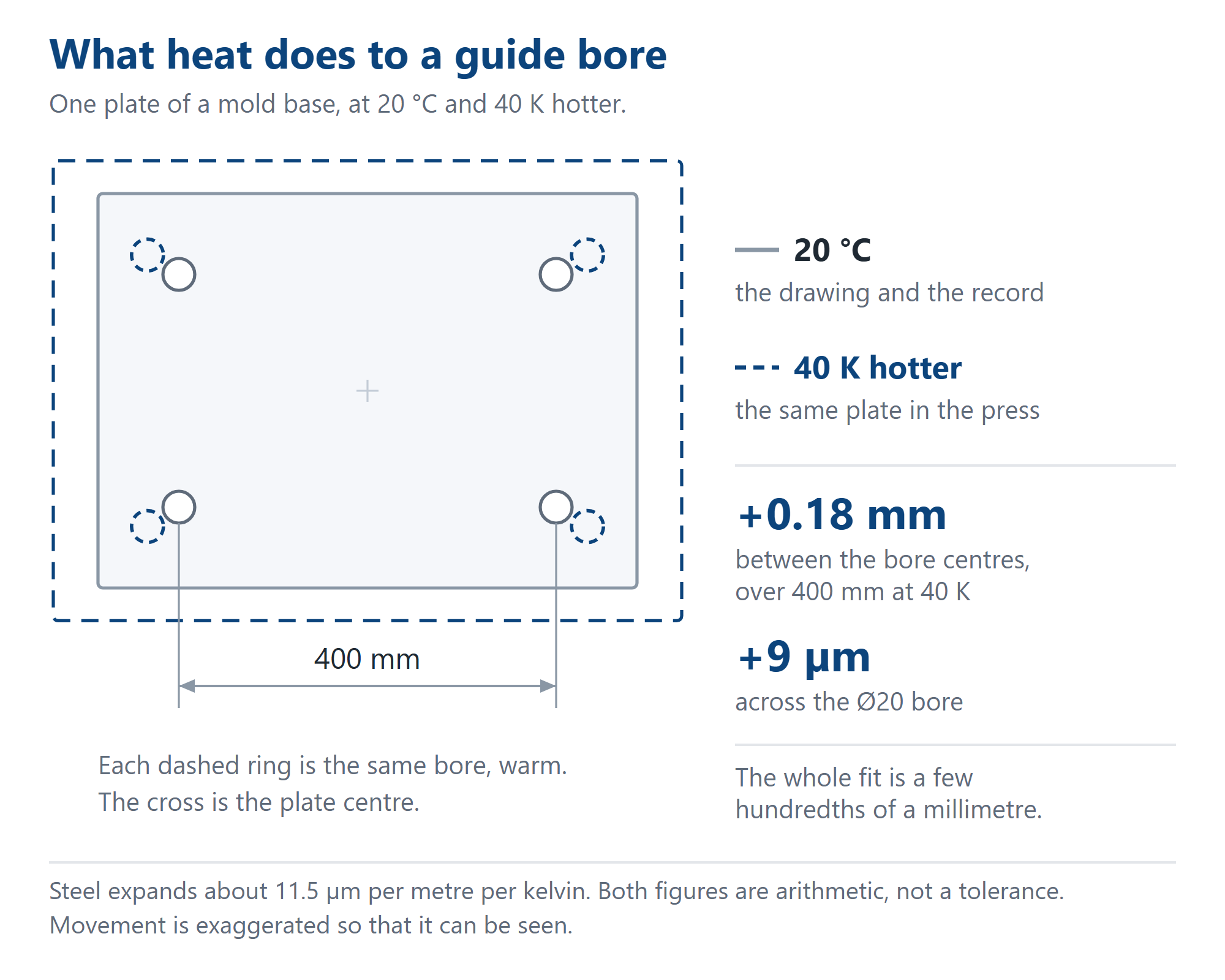
Steel expands by about 11.5 micrometres per metre for every kelvin it rises. The figure looks negligible until it is multiplied out: on a 400 mm plate running 40 K hotter than the room it was measured in, the distance across that plate grows by roughly 0.18 mm. Four hundred times 0.0000115 times 40 is 0.18. Nothing on the drawing changed, and nobody made a mistake.
Three dimensions in a mold base grow at once, and they are not equally important. The plate gets thicker — 40 mm of steel gains about 18 µm. The bores get bigger — a Ø20 guide bore opens by about 9 µm. And the distance between two bores gets longer, which is the one that decides how the tool runs: 400 mm becomes 400.18 mm.
The guide system is where it lands, because it is the only part of the base that has to agree with itself in two places at once. Four pillars stand in one half and four bushes in the other, and each pair has to stay coaxial on every cycle. The clearance that lets them slide is small — an H7/g6 fit on a 20 mm pillar leaves a few hundredths of a millimetre. Against that, a tenth of a millimetre is not a tolerance question. It is several times the whole guide fit.
Here is the part usually missed. If both halves of the stack sit at the same temperature, both grow by the same amount and the bores stay lined up — which is why a hot tool can run for years without a guide problem. The trouble is a difference, not a temperature. The core half of a tool commonly runs hotter than the cavity half, and if the two plates sit 10 K apart across 400 mm, the bore centres separate by about 0.046 mm. That is the entire clearance of the fit, spent before the press has made a part.
A clamped plate also cannot grow the way a free one would. The edges bolted to the platen are held, so part of the expansion turns into stress instead of movement and the plate bows slightly between the clamps. The result is a parting line that closes at the corners and stands a little open in the middle — a figure measured in the same hundredths, and the reason flatness is quoted on the cold plate: it is the only condition both parties can measure.
Three symptoms in the press point at heat rather than at machining. A bright polish or a brassy smear down one side of a pillar with the opposite side untouched: the pillar is being pushed sideways, not worn evenly. A bush that has turned or dropped in its bore: the bore opened as the plate warmed and the press fit that held it went with it. And flash that appears an hour into a run rather than on the first shots, from a tool that closed clean when it was cold.
The instinct at this point is to ask for a tighter tolerance, and it is the wrong lever. Calling the guide bores to ±0.01 mm instead of ±0.02 mm closes the cold fit, which leaves less clearance to absorb the movement, which brings the bind forward. A base built that way passes inspection more convincingly and runs worse. The cold number cannot describe the running condition; only the drawing can.
What helps is information, and it is four lines of it. State the temperature each half will run at, so the fit can be sized for the hot condition rather than the cold one. Say whether the guide system is fixed in both halves or free in one — a pillar located in one plate and allowed to float in the other follows the differential instead of fighting it. Keep the guide system as close to the thermal centre as the cavity layout allows, because movement is proportional to distance: a bore 250 mm out travels twice as far as one at 125 mm. And say plainly that the tool runs hot, because 40 K is a different job from 5 K.
There is a measurement side too. Dimensions are defined at 20 °C — the reference temperature in ISO 1 — and a plate inspected in a warm shop reads large by the same arithmetic. A 400 mm plate at 30 °C is 0.046 mm longer than the same plate at 20 °C, which is more than the tolerance on a fitting face. That is why an inspection room is held at a steady temperature, and why a base is worth checking on arrival, before it has spent a shift beside a warm machine. What an inspection record proves is bounded by the same rule: it describes the part it measured, at the temperature it measured it.
Buying the base from China adds one leg to the temperature question. The plate is machined and measured in Dongguan, China at ambient, sits in a container for weeks, and arrives at whatever temperature the weather and the warehouse give it; the first time it reaches a real working temperature is in your press, in front of your toolmaker. None of that is a defect. It does mean the running condition has to be on the drawing rather than settled at the bench: a Chinese mold base supplier will hold the clearance you ask for and cannot guess the one you did not. That is most of what buying a mold base from China actually involves — putting the operating condition into the document the machine reads.
What it means for an order is small and specific. Fit figures sized for a cold room are the wrong figures for a running tool, and a base is the one part of the tool nobody can adjust once it is in the press. A pocket can be re-cut and an insert re-made; a guide bore that has gone oval has to be sleeved back. One extra line on the drawing, and one question at quotation, is the whole cost of getting it right.
The summary is short: the base is measured cold and judged hot, so write the hot condition down. On our floor, fitting and ground faces are held to ±0.02 mm and ground faces finish at Ra 0.8 µm, which is the tolerance the guide system starts from — not the one that protects it from temperature. Most bases leave in 7–10 days from order confirmation, more than 2,000 sets and pieces a month go through the shop, and the price comes from the factory floor. Put the running temperature on the drawing and the fit can be confirmed before a plate is cut.
Related