

Technical · 6 min read
Where the lifting holes go on a mold base — and why the thread carries the load
Every mold base is lifted long before it is run, and most of those lifts are improvised. The tapped hole, its seat and its depth are a designed load path — and they belong on the drawing.
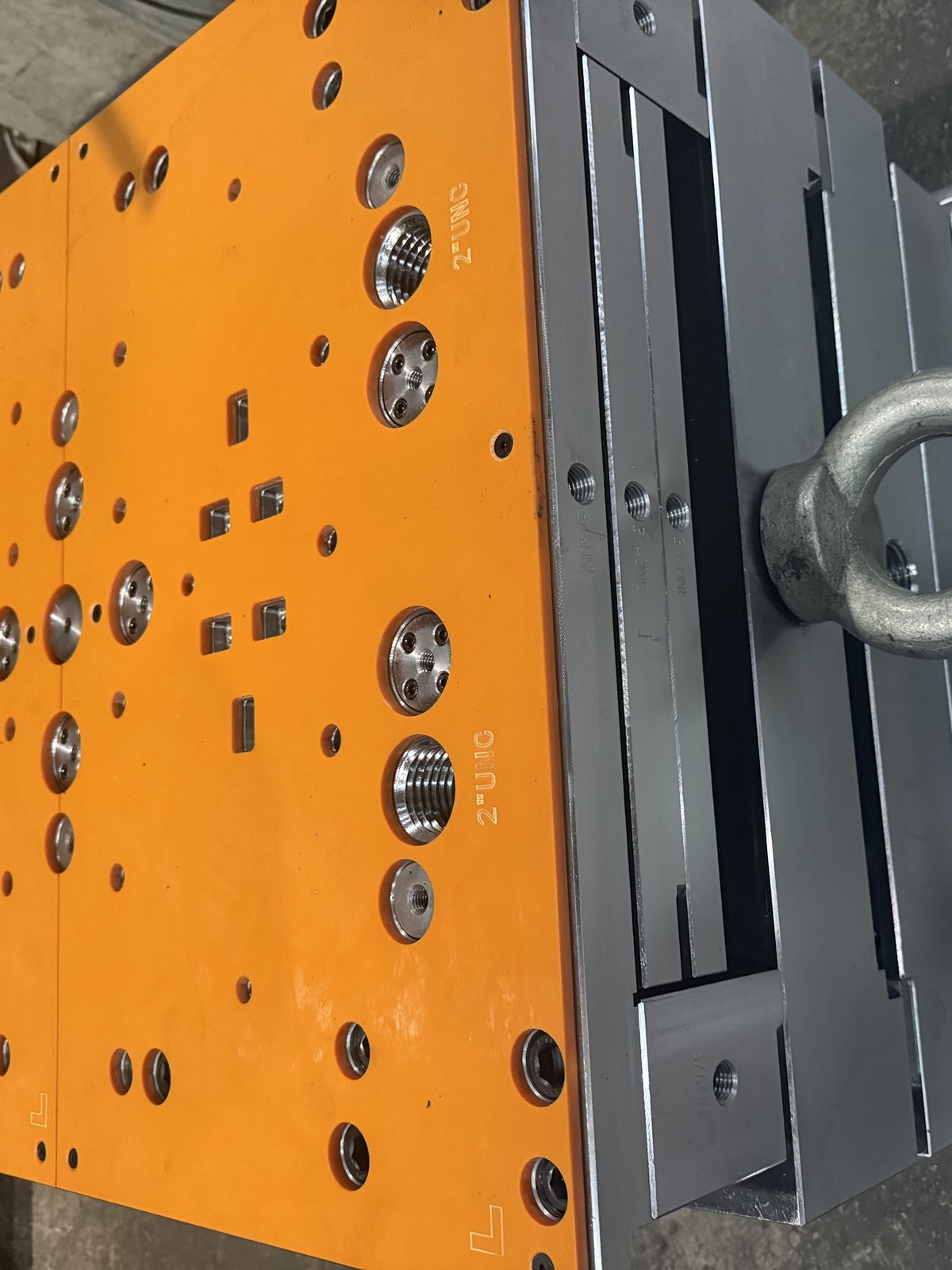
A mold base is handled more often than it is run: off the machine, onto the bench, into the crate, out at the far end, onto the press, and out again every time the tool is stripped for service. Most of those lifts are done with whatever is nearest to hand. The lifting points are usually the last features added to a drawing and the first ones anybody reaches for, which is why they are worth settling before the plate is cut rather than over the phone afterwards.
Two ways to lift a plate, and only one of them is a feature. A sling choked around the plate works and needs no holes, but it also needs clear space underneath, it bears on whatever edge it crosses, and the load goes wherever the sling happens to sit. A tapped hole with a ring in it is different in kind: the position is a decision, the thread is a size, the depth is a number, and all three can be checked. That is the difference between a designed lift and an improvised one, and it costs almost nothing to write down.
The ring is the rated component, not the plate. A hoist ring arrives with a working load limit, and that limit rests on three assumptions: the thread is engaged to the depth the maker specifies, the ring sits flat and square on a machined seat, and the pull runs along the axis of the bolt. Break any one and the rating no longer describes what is hanging in the air. The spot face is not cosmetic — a ring bearing on a raw milled surface rocks under load and puts the pull onto one side of the thread.
Engagement is a multiple of the diameter, not a fixed depth. Ring makers state minimum engagement as a multiple of the nominal thread size, so the hole an M20 ring needs is not the hole an M30 needs, and neither is a number the shop can read off the plate thickness. The thread must be deep enough for the largest ring that will ever go into that tool. And the callout must be a thread depth, because the drill point below the last full thread engages nothing — the same distinction that governs every other tapped hole on the base.
Plate thickness is where the callout breaks. A tapped hole in a thin plate can only engage as much material as the plate has. When the ring needs more there are three honest answers: a thicker pad locally, a through hole with a washer and nut on the far side where there is room, or a different lifting method altogether. What is not honest is a deep callout on a plate that cannot carry it. The shop will either cut it short or break through into a cooling line, and either one surfaces at the wrong moment.
Where the holes go is a centre-of-gravity question. Two holes on one edge give the plate somewhere to hang, but it hangs at an angle and swings about the line between them. Four points near the corners, hooked so the crane block sits over the centre of gravity, hold the stack level and stop it turning. On a base with a deep core on one side the centre of gravity is not the geometric centre, so either the lifting points move with it or the lift needs a spreader. Four holes spaced evenly on an off-centre stack will not hang balanced.
Clearance matters as much as position. A lifting hole belongs in solid material: outside the pocket, clear of the guide bores and the ejector holes, and above all clear of the waterlines. A tapped hole is a blind pocket, and one that intersects a drilled circuit becomes a leak path that no pressure test finds until the tool is warm. The plate in the photograph has a hoist ring seated in it, and large tapped holes stamped with their thread size beside each one — the ring is matched by reading, not by measuring at the crane.
The direction of pull decides the hardware. An eye bolt is rated for an axial pull; pulled at an angle it bends, and a bent eye is a hook that has lost both its shape and its rating. Where the lift will always be off-vertical — turning a tall stack, or lifting with the crane block in a corner of the shop — the right part is a swivel hoist ring, which turns to follow the sling instead of fighting it. Specifying eye bolts for a tool that will be flipped is specifying the cheaper part for the harder job.
Which plate carries the lift. The load goes into the plate that stays with the crane when the stack is split, normally the top clamping plate — and once the tool is assembled, that is also the plate still reachable. Lifting points that end up under a locating ring, a hose bracket or a clamp strap are no use in service. If the base ships as part of a complete mold build, the weight the holes must carry is the finished tool, not the bare base, and the gap between the two is not small.
Six lines on the drawing settle it. Thread series and size, inch or metric — the two are not interchangeable, so a Chinese mold base is cut to whichever the drawing names and to nothing else. Thread depth. Whether the seat is spot-faced. How many holes, and on which plate. Position, or a note that they sit on the centreline near each corner in solid material. And whether the rings ship with the base or are bought locally. Written this way the holes are checked like any other feature, and a repeat base six months later gets the same lift without another conversation.
Lifting points are packing points too. A base with four sound holes can be loaded and unloaded without a sling touching a ground face, and a ground face with a chain dragged across it is a face somebody has to re-work — which is part of what oversize packing protects. At the far end the same holes are what the customer's own shop will use. A tool that arrives with no way to lift it gets lifted by whatever is to hand, and that is where a finished base picks up its first mark.
None of this is expensive. Four holes, a seat, a depth and a stamp cost a fraction of a dropped plate, and the decision is free while the drawing is open. We cut lifting holes to the drawing and tell you when a plate is too thin for the ring you have named. Bases are machined in Dongguan, China, on 20+ three-axis machining centres; a normal order runs 7–10 days from confirmed drawing to shipment, the plant turns out 2,000+ sets and pieces a month, and you buy from the factory. If you are still working out what buying a mold base from China involves, settle the lifting points early.
Related