

Complete builds · 7 min read
A complete mold build: where the frame ends and the inserts begin
Four boundaries between a frame and the inserts that drop into it decide whether the tool closes cleanly: the pocket, the parting plane, the water and the ejector. Buying them as one order is about who owns those four — not about the discount.
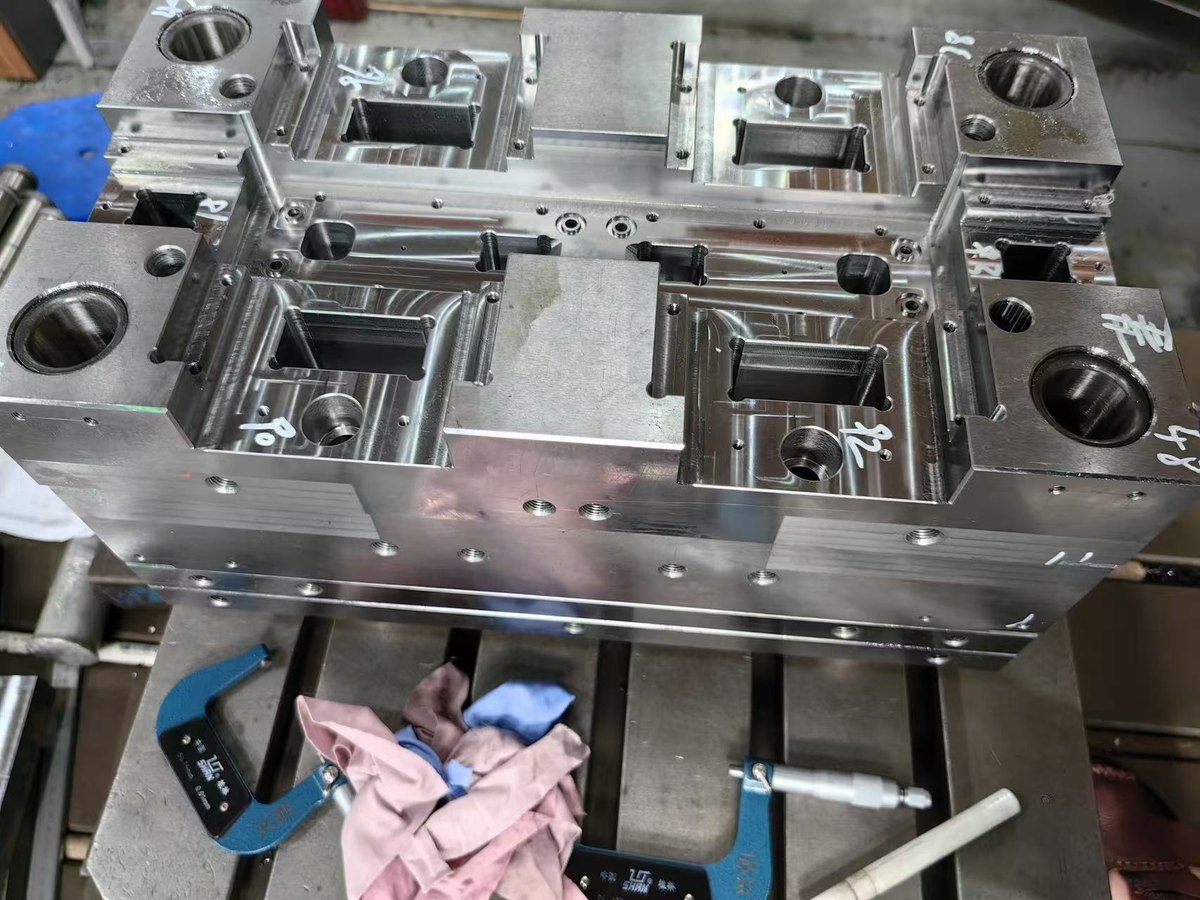
A base leaves this shop as a stack of plates machined and measured against one another. A mold leaves as a set of parts that have to agree about a boundary. The pocket must accept the insert, the insert must stop at the parting plane, the water must cross from plate to insert without a step, and the ejector must arrive under the part. Not one of those is settled by either part on its own. That is the argument for ordering frame and inserts together — one datum, one inspection record, one party to call — and it has nothing to do with the discount.
The pocket is cut to the insert that will sit in it. A drawing gives a pocket size and an insert size, each with its own tolerance; if two shops hold their own bands, the gap is the sum of the two. A pocket slightly loose does not announce itself — the insert drops in, the screws pull it across, the tool closes — but everything the insert carries has moved: cavity, shut-off edge, core. Slightly tight is worse, because the insert goes in under pressure and the plate is sprung around it. On one order the pocket is cut after the insert is measured, so the fit is a decision rather than a coincidence — the discipline a cavity pocket layout calls for before the plate is cut.
The figure that matters is a difference. An insert sits on the floor of its pocket while the plates close on each other. What decides whether they do is insert height minus pocket depth. Proud by a few hundredths and the stack closes on the insert: the parting faces never touch, the tool flashes along the shut-off, the pillars lose the preload they were bored for. Low by the same amount and the insert hangs on its screws until injection pressure gets under the cavity. Neither figure can be inspected on one part alone. It is a stack-up, and a stack-up needs one shop holding both halves of the subtraction.
Water does not stop at a plate boundary. A circuit drilled into the base and continued into the insert meets at a joint that has to line up and seal. From one datum the two halves meet on the same axis; from two datums they meet with a step — enough to cost flow, and enough to push an O-ring off centre in its counterbore so it seals one side and weeps the other. A weep does not show at assembly. It shows warm, with the tool in the press a week before the run is due. Deep-hole drilling of a cooling circuit from the base side only works if both sides are drilled to the same reference.
The ejector pattern is one pattern seen from two sides. The holes in the ejector plates and the holes in the core insert are the same layout, reached from opposite ends of the stack. Cut from a print in two places, the pattern collects two datum errors and the pins either bind or land off the mark — a mark the part carries on every shot. Bored inside one setup family it is a match. Ejector pin holes are the cheapest of the four interfaces to get right and the one most often left to whoever drills last.
What a complete build puts in the crate. A base alone is plates, pillars, bushes and tapped holes. A complete mold build is cavity and core inserts to the same steel callout, the ejector and guide systems assembled and spotted, cooling fitted and blanked for transport, cavity dimensions recorded on the CMM, then film wrap and a wooden case. The last step is the one that decides whether the two halves actually touch — blue off one half, high spots stoned back, until contact is even across the shut-off — and it cannot be done by correspondence. A split order usually leaves it to the customer's tool room — legitimate, provided somebody names the decision.
What it does not cover. A hot runner is a bought-in system with its own supplier and its own wiring. Texture is a separate process on its own lead time. Tryout on your press belongs to whoever runs the press, because the machine, the material and the part are variables we do not own. Polishing beyond the faces named on the drawing, the customer's own standard components, and the tuning only the molder can do all sit outside a build. A quotation that swallows them silently re-opens later, and re-opening always costs more than the line item.
Five lines the drawing has to carry. The part model or mold assembly as STEP or IGES, because a 2D print leaves sculpted faces to interpretation. The 2D drawing with its tolerance class, and which faces are functional. Steel for base and inserts separately — 718 / 1.2738, 1.2311, or 1.2344 for a die casting die — and whether any of it is hardened after machining. The press: tonnage, tie-bar spacing, maximum mold height. And one line naming who does the final spotting, which is the one buyers forget.
Splitting the order is sometimes right. If the base already sits in your tool room, buying inserts to fit it is the only sensible order — then the base has to be measured rather than assumed, and the interface drawing has to say which part is nominal. If the cavity comes from a licensed tooling system, that supplier may own the insert geometry. In all three cases the interface becomes a written drawing: pocket size, insert size, the datum both are measured from, who owns the fit. A split order is not a worse order; an undefined interface is. It is what frozen and open lines settle before anything is cut.
Where the split usually falls in a Chinese frame order. Much of what moves through this trade is a frame: plates, guide system, ejector pattern, pockets cut to a size on a print. That is a clean, well-defined product, and plenty of Chinese mold base suppliers quote exactly that and stop — not a criticism; it is what the drawing asked for. The question worth asking first is whether the pocket is being cut to a number or to a part, because only the second transfers the fit. If you are still weighing up what buying a mold base from China involves, put that question in the first email.
We machine frame and inserts in the same shop in Dongguan, China, on the same 20+ three-axis machining centres, holding fitting and ground faces to ±0.02 mm and ground surfaces at Ra 0.8 µm; plates over 600 mm are agreed piece by piece. Assemblies are measured on the CMM before packing and the records travel with the crate. A normal base order runs 7–10 days from confirmed drawing to shipment, the plant turns out 2,000+ sets and pieces a month, and you buy from the factory. A complete build is quoted with its own date, because insert work is not the frame's job — but it is the same datum, and that is the whole point.
Related