

Buying guide · 6 min read
Which mold base do you actually need? A buyer's guide to the lines we machine
A first enquiry usually arrives as a drawing and one question: what kind of base is this, and what should it cost? Three things decide the answer.
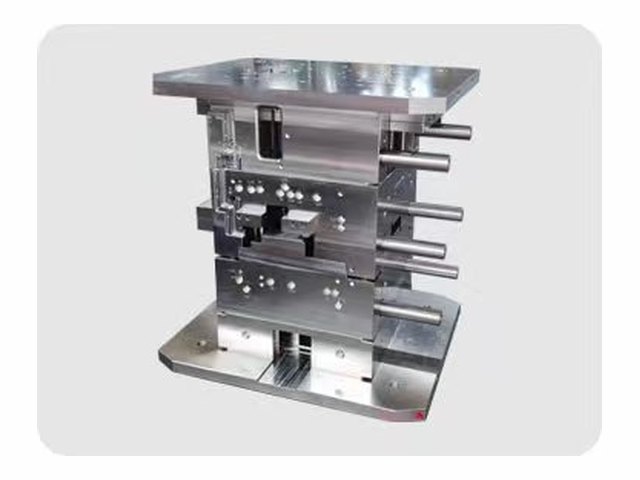
Every base is a plate stack first. A mold base is a set of plates held parallel to each other, with pockets cut for the cavity and bores bored for the guide system. Standard, frame, die set, injection base — those names are shorthand for a handful of decisions about that stack: plate size and thickness, pocket layout, guide system, and which faces are held as fits. Sort the stack and the name follows. Sorting the name first is how buyers end up paying for a catalogue base that then has to be re-machined.
Standard plastic mold base. The fastest route into production, and the cheapest machining hour you will buy. Sizes, thicknesses and cavity layout follow a pattern we machine every week, so nothing is engineered from scratch: pin-point gate, three-plate and side-gate systems, in the grades buyers normally specify. Choose it when your part fits a size that already exists — a standard plastic mold base in a known pattern is quoted and scheduled in days.
Injection mold base. More than two plates. An injection mold base is the complete A/B plate assembly — guide pillars and bushes bored to position, the ejector pattern drilled and tapped where your design needs it. Buy the assembly so the pillars, the bushes and the ejector pattern line up with your cavity work — one shop machined them together, rather than each plate arriving true to itself and untrue to the others.
Plastic mold frame. The shell your cavity insert drops into. If the insert is already made, or being made elsewhere, a mold frame is what you need: a matched plate set with the pocket, cooling and ejector pattern per your drawing. What matters is not any single dimension but the relationship between the plates — parallelism between the mounting faces, squareness of the datum, and the pocket positions. We machine frames as matched sets and keep them together.
Custom non-standard mold base. Most of what leaves this shop. A cavity layout that does not fit a catalogue, a cooling circuit that has to route around a slider, an ejector pattern dictated by the part — a custom base is normal work here, not a favour. Send the drawing in DWG, DXF, STEP or IGES, or a clear photo of the print. Non-standard does not mean slower: most custom bases leave inside the same window as a standard one.
Precision ground mold base. The same stack at a different standard of finish. If the part is thin-walled or cosmetic, or the mold will run at high pressure, the faces that close the cavity have to be ground rather than milled — a precision ground base is the answer, and why ground faces matter sets out what grinding changes and which faces are worth paying for. Unsure whether your job needs it? Send the wall thickness and the annual volume.
Die casting mold frame. A harder environment: higher melt temperatures, a fast thermal cycle, and a frame that expands and contracts thousands of times. A die casting frame is built as a heavier plate set, with wear-resistant construction where the melt and the moving parts work hardest. Here the alloy, the casting weight and the cycle rate decide the construction — tell us all three.
Die set — hardware tooling. Press and forming tools, where the guide system is the whole story. A die set that guides cleanly stamps cleanly; one that guides loosely wears the punch and the die in proportion to the strokes it has taken. Matched plate pairs with guide posts bored to position, to your drawing rather than a catalogue.
Large mechanical plate machining. When the job is a plate rather than a mold: oversized plates, base plates and machine parts to print, on our own three-axis centres, with the crane and the floor space to handle large sections. Flatness and parallelism are the two figures that matter, and above 600 mm the tolerance is agreed case by case — large plate machining.
Special steel supply. Buy the steel with the machining and any question about the material has one party to answer it. We machine the ten grades buyers most often specify — S50C (1.1730), P20 (1.2311 / 1.2312), forged P20, 718, 718H, 738, 738H, 4Cr13, 420H and S136H — and can supply the steel together with the base, cut for the size you actually need rather than the nearest stock size (special steel supply).
Complex surface and functional structure bases. Not every base is a set of parallel plates with holes in them: sculpted surfaces, angled shut-offs and interlocking geometry that has to mate with a moulded or cast part. These are the jobs where the machining decides whether the design is buildable at all, quoted individually against the model (complex surface mold base).
Two-color (double-shot) bases. Two materials, one cycle, one frame. The registration between the first and second shot is decided by the base: if the locating features drift, the two materials drift with them. Tell us which faces locate the second shot, and they are called out as fitting features and bored in the same setup (two-color mold base).
Where wear is the real problem rather than geometry — very high shot counts, abrasive melts, steel sliding on steel — we also supply mold bases at HRC52 hardness, quoted individually against the application and the place the wear actually happens.
Three questions pick the line. Does the geometry follow a pattern we machine every week, or does it come off your drawing? Does the base carry the cavity, or frame an insert made elsewhere? And what does the production life look like — a short run, a long one, a corrosive melt, a die casting cycle? Answer those and the line picks itself; the full range is set out on the products page.
What to send with the enquiry. The drawing, with the functional faces marked and the datum identified; the annual volume; the machine the base goes into; and the destination, because packing follows the route. The RFQ checklist covers the full list, and the tolerance note covers how to call out the figures that matter.
The shop is the same behind every line. Standard bases leave inside our seven-day window; at 2,000+ sets a month the week is planned as one job; and everything is machined on our own machines, so the price you approve is a factory-direct price. Minimum order is one set, prices are quoted FOB China against your drawing, normally within one business day, on 50% deposit and 50% before shipment.
Send the drawing and tell us which of those three questions is still open. We will tell you which line the job belongs to, and what the base will hold, before you commit to a price.
Related