

Product / case · 6 min read
Stroke is a stack dimension, not a pin length
The travel lives in the gap the spacer rails leave. Eight lines for a plate list, what pulls the plates back, and how to verify the stroke on an assembled base.
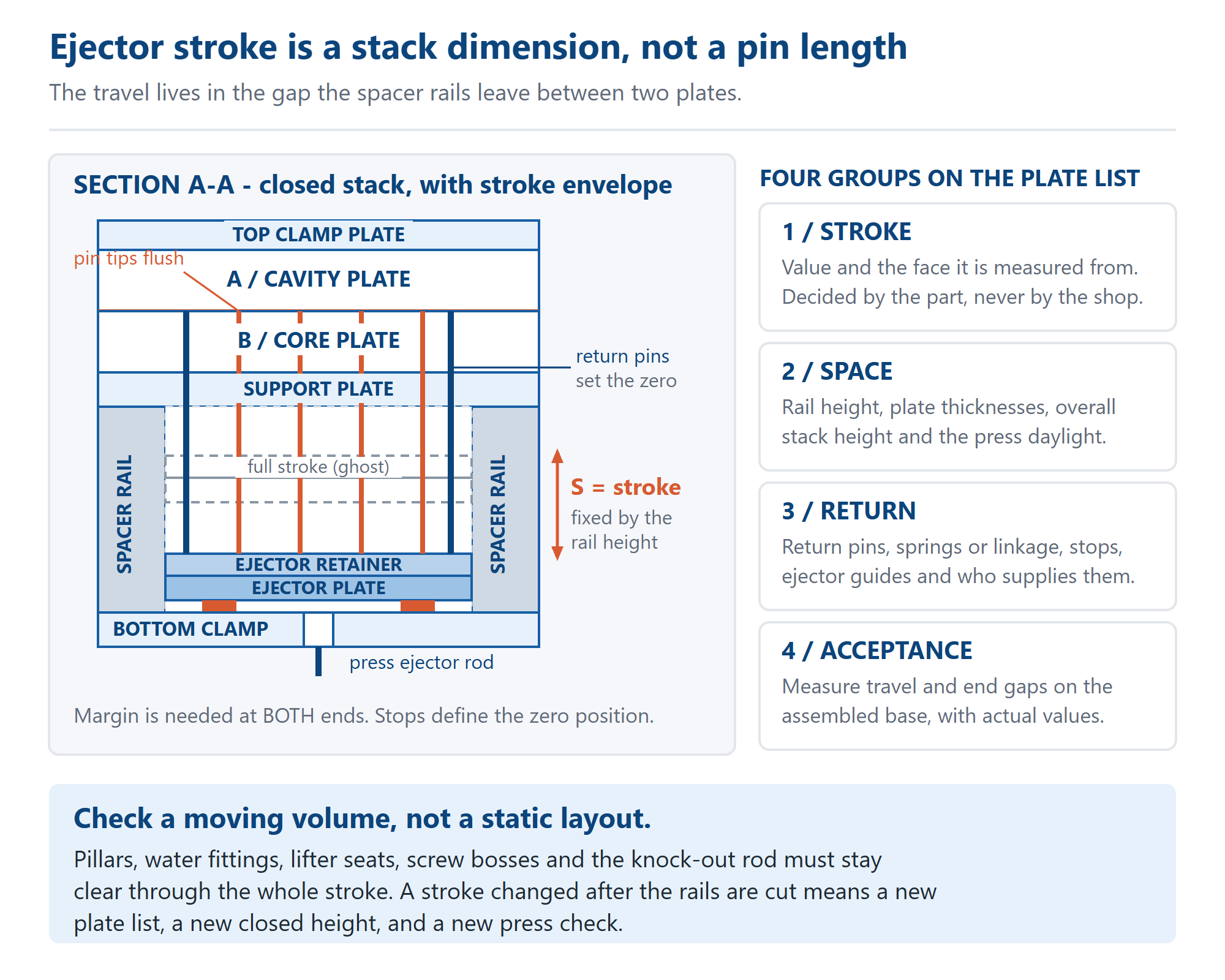
Ejector travel is usually the last number to reach a mold base drawing, and often it never arrives: the note says “stroke as per your standard”. That hands a stack-level decision to the shop. Stroke is not a property of a pin; it is the distance the ejector plates can move in the gap the spacer rails leave between the support plate and the bottom clamp plate. Fix that gap and the pins, return pins and stops follow. Leave it open and the stroke is measured only after the plates are cut.
Stroke comes from the part, not the base. Travel is set by the undercut, the height of the part on the core, and the clearance it needs to fall clear. A mold base supplier cannot derive that from a plate list. Ask the tool designer for a number and for the face it is measured from — parting face, core face, or the closed position of the ejector plate. The same figure read from a different origin is a different stroke. What an order contains lists the plates; this is the dimension to add.
The travel lives in the spacer rails. The ejector assembly floats between the support plate and the bottom clamp plate, and that gap is the height of the two rails. Rail height covers both plate thicknesses, the stroke and a margin at each end: at full stroke the assembly must not land hard on the support plate, and at full return it must sit on its stops without the pins standing proud. Neither margin is a universal number, and we will not supply one — it depends on plate size, pin pattern and guidance. Rail height also sets stack height, a machine interface covered in where the base meets the press. Change the stroke after the rails are cut and you change the plate list and the closed height.
Return pins fix the zero position. They bring the ejector plates back to a defined closed position as the tool shuts, so the pin tips sit flush again. Length follows the stack, not a catalogue: too short and the assembly never reaches its stops; too long and it holds the plates apart. The ejector hole note explains why a pin passes through three different bores; return pins add a fourth requirement, a definite end position. Put their diameter, length and coordinates on the plate list and name the face they are set flush with.
Decide what pulls the plates back. Springs in pockets, an early-return linkage, or the press ejector rod drawing the assembly home each ask for different holes: spring seats, linkage clearance, or a positive connection at the knock-out. Name the method, who supplies the hardware, and whether it ships fitted or bagged; the spare-parts record is where those designations belong later. A wide plate with an offset pin pattern also needs ejector guides — separate from the main guide pillars, with their own bores and fit.
Stops are where “returned” is defined. Stop blocks give the ejector plate a hard, repeatable zero, and decide how much of it bears on the bottom clamp plate. A few small stops under a wide plate let it rock; fit none and it beds on swarf or pin heads. Their positions, heights and supplier belong in the components list beside the springs and pins. A photograph of the assembled stack before crating is cheaper than finding out at the press that the stops were never fitted.
Check a moving volume, not a static layout. Everything in the rail gap must stay clear through the whole stroke: support pillars, water fittings, lifter seats, screw bosses, the knock-out rod and cabling. A layout drawn at the closed position can pass every check and still collide at full stroke. Mark the swept envelope on the assembly view, and write the clearance rule beside it: holes stay where the part needs them, moving parts are routed around them.
Inspection belongs on the assembled base. Plate thicknesses and bore positions measured one at a time say nothing about the stroke. Push the ejector plate to both ends, measure the travel achieved and the gap left at each end, and record the values with the datum face they came from. On fitting and ground faces our own callout is ±0.02 mm with a ground finish of Ra 0.8 µm — our shop specification, not a claim of compliance with an external standard. What an inspection record proves: “OK” is a decision, not a size.
Eight lines settle it. The stroke value and the face it is measured from; spacer rail height and the resulting stack height; ejector plate and retainer plate thicknesses; return pin diameter, length and coordinates; the return method and every hole it needs; stop and limit positions, heights and supplier; ejector guide specification, if fitted; and how stroke and end gaps are verified on the assembled stack. Attach the list to the plate list, not the covering email, and have the written order confirmation repeat the stroke figure back. Eight lines cost nothing at quotation and a new set of rails afterwards.
When you source a mold base from China, this is mostly a documentation problem. A buyer working with Chinese mold base suppliers cannot walk to the assembly bench and point at the stroke they meant, and a photograph of a finished stack does not say what the closed position was. The drawing has to carry the number and its datum. Our shop in Dongguan, China cuts the rails, bores and seats from the plate list; sending the eight lines with the enquiry is what makes the first assembly match the second. Distance adds no extra party — it removes the informal conversation that would fill the gap. That is one practical part of what buying a mold base from China actually involves.
Read the symptoms backwards. A part still hanging on the core: a stroke or rail gap never dimensioned. Pin tips leaving witness marks: the assembly is not reaching its stops. One side leading, with a bright rub mark on a return pin: ejection guidance, not pin size. A knock at the end of the closing stroke: return pins too long for the stack. Each turns up on the press, and each traces back to a line missing from the plate list.
Send the stroke figure, the datum face and the eight-line list with the enquiry. We confirm what the stack can hold before quoting rather than after. The same applies whether you order a standard plastic mold base, an injection mold base, a set of mold base components or a custom non-standard base. Ordinary custom bases from our Dongguan, China mold base lines usually ship in 7–10 days; capacity is 2,000+ sets and pieces per month; and you deal directly with the factory that cut the rails — so the person answering a stroke question stands at the machine.
Related